
Can I sell my California construction contracting business?
Every owner of a construction contractor believes that their business is valuable. And…indeed it is, to them…if the business is compensating them well through excess salary, bonus, perks, and distributions. But, when the owner retires, can the business be sold?
It depends.
1) Size matters. It is easiest to sell construction companies with more than $10 million in revenue that are growing faster than inflation.
2) Profitability is key. Your business should be consistently profitable. No volatile ups and downs. Especially no losses. Ideally EBITDA margin is 10% or higher. It is best if profits grow with revenue and even better if EBITDA margin improves with growth.
Ideally your business revenue and profitability look like the graph below:
-
- Revenue growing consistently, faster than inflation
- Profits growing with revenue, even better if faster as a % of revenue.

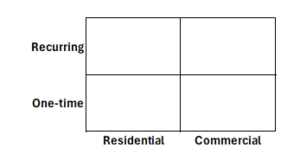
3) Revenue type matters. In general buyers prefer recurring revenue – like contracted maintenance revenue. One-time revenue, like construction revenue, is less attractive. Repeat revenue, like annual inspections or maintenance is somewhere in-between.
4) Customer mix is important. Private equity-backed firms tend to prefer contractors that serve commercial customers rather than residential customers. Commercial projects tend to be bigger. They often include recurring revenue through maintenance contracts or at least repeat revenue. Operations are more professional. And customers pay on time and rarely default.
Where does your construction business fit in this 2X2 matrix?
5) What is the plan for the contractor’s license? The California CSLB (contractors state license board) requires that all contractors have a contractor’s license. For most contractors, the license is held by the business owner, the RMO (responsible managing owner). If the business sale is financed with an SBA loan, the former owner cannot stay on as RMO or RME (responsible managing employee). Many construction business owners don’t know this.
6) Do you know the buyer? If you are selling to a family member or a trusted employee in an MBO (management buy-out), it is likely that they won’t have sufficient funds and may not qualify for a loan. This means that the Seller may have to finance the transaction.
Many small-to-medium-sized construction contractors simply wither away. Some get passed to the next generation. The best ones get sold.
Often I hear, I have been in business for 20 years…I have lots of goodwill in the community. Remember, there are two types of goodwill, financial goodwill and community goodwill. Financial goodwill is driven by revenue and profits. Community goodwill is basically reputation. While community goodwill is important, only financial goodwill truly matters when selling your business.
If you plan to sell your contracting business when you retire, start planning now. Start working with a strategic business consultant, a CEPA (certified exit planning advisor), or a CExP (Certified Exit Planner) now. Groom your business to be sold. Don’t wait until the last minute, only to learn that your contracting business is not attractive to strategic and financial buyers.
—————————–
Roy Martinez is an m&a business intermediary at Exit Strategies Group, Inc. in Sonoma County, CA. He helps owners of businesses with $5-50 million in sales sell their business. He recently helped a construction contractor complete an MBO. Roy can be reached at m 707-849-5040 and jroymartinez@exitstrategiesgroup.com.
Note: I am not a strategic business consultant, a CEPA, or a CExP. But, I would be happy to connect you with one.