Six Reasons NOT to Skim

Pulling unreported cash receipts out of a business is indefensible and unwise under any circumstances, but particularly if the owner expects to exit in the next 3-5 years.

All of us during our childhood were offered the parental edict: “Don’t do it, you are only hurting yourself.” So “why”, you may ask . . . now that you are a grown adult, “should I not skim?”

Many reasons immediately come to mind and I am certain that we could all come up with many more, but in the interests of brevity, I’ll keep it to six reasons.

  1. Skimming is against the law. Tax evasion is a felony.
  2. Management of your business becomes more challenging. Skimming requires you to underreport revenues which means your cost of sales percentage rises. Cost containment and inventory control are more difficult to assess.
  3. Loss of Employee, Partner and Spousal Trust. You set a bad example and create a fertile ground for others to steal. Worse yet, a disgruntled employee or retaliatory ex-spouse or partner could report you.
  4. Bank Loans are difficult to secure, for you and potential buyers.
  5. The value of your business declines.
  6. The marketabilty of your Business is severely compromised. You cannot expect potential buyers to trust you, let alone make a “leap of faith” and pay a premium for your business on the merits of unreported, unverifiable income.

Hopefully this doesn’t apply to you. But, if it does, what’s the solution? I refer you back to your childhood: Don’t Do It.

  1. Stop Skimming
  2. Clean up your books.
  3. Effectively manage your business, using reliable financial records.
  4. Redeem your credibility with your staff, your partners and your bank.
  5. Add value to your business as an ongoing entity or as a potential sale. The amount you no longer skim can easily be worth 2 – 5 times its selling value, or more, depending on the degree of skimming and the size and nature of your business.

In summary, each of us at some point makes a life defining decision … “Do I want to eat better or sleep better?”  You make the call.  As it relates to preparing a business to sell, you can do both.

Don Ross is a seasoned business broker with Exit Strategies Group. He can be reached at 707-778-0210 or donross@exitstrategiesgroup.com. 
Goethe on Exit Planning

Early this morning at my Rotary meeting I heard a quote that struck a chord with me. Our speaker, Stephan Stubbins, recounted the story of how he co-founded a successful theater company that helped save one of our local state parks. Once Stephan and his partners quit their jobs and fully committed themselves to starting a theater company, things started to happen for them.

The quote he shared is by Johann Wolfgang von Goethe ( 1749 – 1832) the prolific German writer, scientist and statesman …

“Until one is committed, there is hesitancy, the chance to draw back, always ineffectiveness. Concerning all acts of initiative and creation, there is one elementary truth the ignorance of which kills countless ideas and splendid plans: that the moment one definitely commits oneself, then providence moves too.

All sorts of things occur to help one that would never otherwise have occurred. A whole stream of events issues from the decision, raising in one’s favour all manner of unforeseen incidents, meetings and material assistance which no man could have dreamed would have come his way.

Whatever you can do or dream you can, begin it. Boldness has genius, power and magic in it. Begin it now.”

We’ve all seen how the act of truly committing one’s self to an idea or goal, sets events into motion, some planned and some fortuitous. Committing to an exit plan works that way too.

Thanks for the reminder Stephan! Click here for information on Transcendence Theater Company

Do Your Business Emails Convey Professionalism?

Normally we blog about M&A or Business Valuation issues, but this week I want to address email effectiveness, a subject important to all business people considering the tsunami of email messages most of us receive each day (an estimated 121).

I recently read an article from the Harvard Business Review that succinctly focused on important do’s and don’ts regarding business emails, including:

  1. Do keep emails brief, clear and to the point to capture attention and interest
  2. Don’t cc the world – consider the true relevance of your message to each recipient
  3. Do be sure your message shines through and is easily understood
  4. If you are asking for a response, say so upfront

Click here for the full article.

And, of course, Email isn’t always the most appropriate form of communication. Before you fire off that next Email, consider whether a phone call or in person conversation might be more effective!

Contact Jim Leonhard, CVA MBA at 916-800-2716 or jhleonhard@exitstrategiesgroup.com.

Economic indicators help put the current U.S. economic climate in perspective.

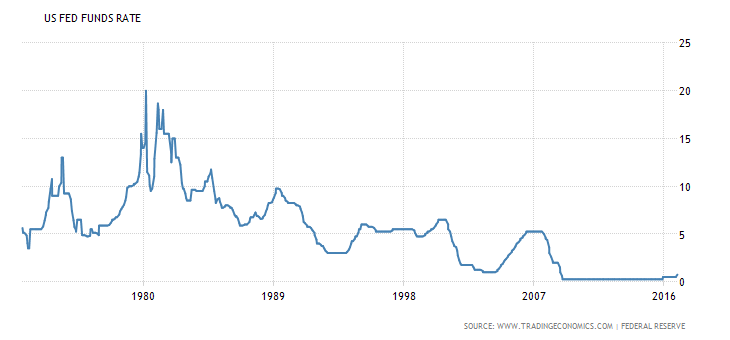
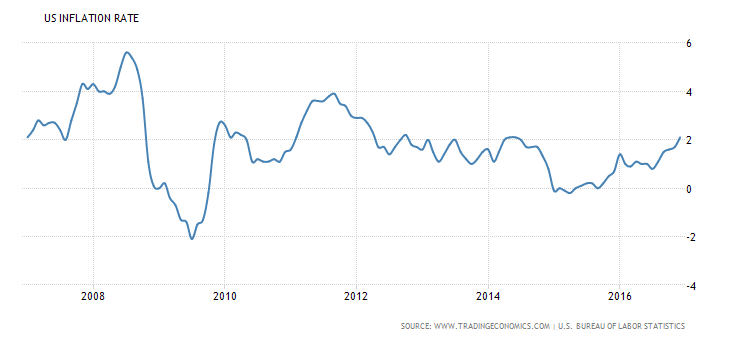
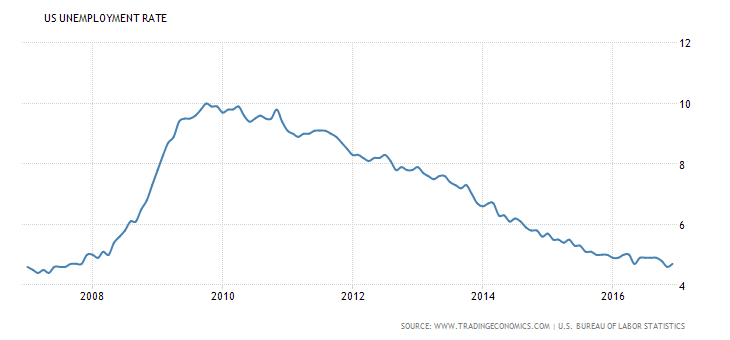
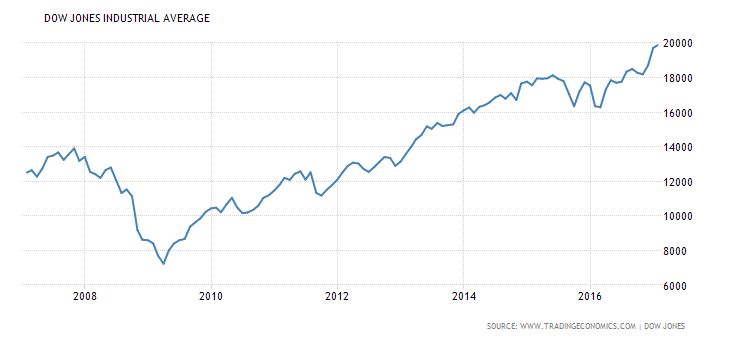
I have four common gauges of U.S. economic activity that deserve a few moments of your attention today: stock market, interest rates, inflation and unemployment. Let’s look at graphs of each of these measures for a visual perspective on the state of our economy.

Stock Market. The Wall Street Journal, Equities pg. B17, January 25, 2017 reported the DJIA rose 100 points amid expectations of increased government spending on infrastructure projects.  The DJIA crossed the 20,000 mark during trading on Wednesday, January 25.US-stock market

Interest Rates. The Federal Reserve raised the target range for its federal funds by 25 basis points rate to 0.5 percent to 0.75 percent, during its December 2016 meeting.US-interest-rate

Inflation. Inflation has been hovering below 2%, the Federal Reserve Open Market Committee has indicated a long-term goal for the inflation rate at 2%.US-inflation-cpi

Unemployment. The unemployment rate has been dropping slowly and steadily since it peaked during the Great Recession.US-unemployment-rate

Overall, the present U.S. economy looks good with rising stock valuations, low interest rates, low to moderate inflation, and declining unemployment. While we can’t predict what the future holds, we can look at recent history to get a perspective on current economic conditions. Thanks for your attention!

Rising Interest Rates and Investment

Since July, the benchmark interest rate, the US 10-year treasury bond, has risen from 1.35% to over 2.55%. That’s a very big move in a short-period. Post-election day the rising rate trend accelerated. We saw a similar spike in 2013, only to see rates retreat. Is it different this time?

Valuation Building Block

Markets seem to believe that current rates are sustainable and can keep rising given the lower tax and infrastructure spending pronouncements coming from the new president elect. Interest rates are building blocks in asset pricing. Generally, when rates change business, individuals, and investors will re-examine their assets and shift them around to reflect their risk and return preferences. The expectations for changes in asset prices can take on near-term speculative fever: “Wait, I need to buy before it gets more expensive!” or “Wait, I need to sell before this thing tanks!”

Stability vs return; fear vs. greed (the two emotions that drive market prices). What return can you expect on your investments – be they stocks, bonds, real estate, or a business? It’s seldom a simple calculation. If predicting financial markets were only about numbers, math professors wouldn’t need to profess!

Since the election, US equity markets have climbed and bonds prices have sunk. Bonds reaction to rising rates is predictable. Bonds are “fixed-income” meaning its coupon rate remains the same regardless how interest rates move; however, when rates rise bonds lose market value because newly issued bonds have higher coupon rates, hence more value to you.

Will the Trump rally continue its ascent? Investors will eventually begin the stability vs. return tug of war. The Federal Reserve announced its intention to raise rates three times in 2017. This may or may not materialize. However, if bond yields do rise, many will trade bond stability over higher, more volatile equity returns which could create less demand and lower prices for equity – both public and private.

Is the “New Normal” Fading?

The “new normal” camp sprang from the 2008-09 crisis. Proponents argued that an aging U.S. population and high debt levels would bring on a Japanese style deflationary environment; and that technology and automation would depress middle-class wages and reinforce lower price trends. In fact, wages have stagnated for over 10 years and rates have stayed historically low. The long-term average on the 10-year treasury bond is 5%; even with the rapid rate rise since July, we are still at half the long-term average.

On the other hand, lower prices spur consumption; and wages have started to show some improvement. Add some fiscal stimulus, a deregulatory minded White House, and government spending: Boom – Keynesian animal spirits will prevail!

However, a few wild cards worth considering: will political rhetoric be matched with real action that might incite a trade war? Will lower taxes and government spending on infrastructure spur growth without impacting the U.S deficit? Will financial reform of Dodd-Frank create the same mess that brought us to Dodd-Frank?

These type considerations will impact our domestic economy and the business environment. Low rates have helped prop up equity valuations, made real estate more affordable, and allowed businesses to lower their capital costs. Rising rates may create a headwind.

Risk of Return

Indeed, rate increases mean the cost of capital is going up. We business appraisers use the “build-up method” which begins with the US Treasury rate and “builds up” a required rate of return based upon various risk factors. If the rise in rates is accompanied by higher growth in revenue and profit, valuations can remain high. However, if rates climb, growth stagnates, or inflation eats into profits, it most likely will have a downward push on business value (both public and private markets).

Buried in the Corporate Archives – a Valuation Case Study

A lot of our valuation work is done for the purpose of internal share transfers of private businesses, or buy-sell transactions. In doing this work, we often see that owners have overlooked or neglected to keep important documents up to date. One such document is the buy-sell agreement, which articulates important legal, tax, valuation and financing issues that are important to ensuring smooth share transfers and business continuity.

We recently evaluated a holding company with a fair market value of approximately $40 million dollars. Two shareholders each owned a 50% interest in the company, a C Corporation, and one wanted to sell their stake to the other. The client said during our initial conversations that there was no buy-sell agreement in place, so we proceeded with developing a Fair Market Value opinion of a 50% interest. Just to be safe we requested a copy of “any agreements governing  or restricting the sale of shares”.

Guess what? Just as we were wrapping up the valuation, the client came across a type-written copy of the corporate buy-sell agreement executed in 1982. The owners and officers had been unaware of its existence. Hence, it hadn’t been updated and they certainly weren’t aware of its terms and provisions. As we reviewed the agreement, we found that it prescribed that any transfer of company shares would be at book value. In this case, book value was less than $1 million dollars.

A buy-sell agreement is a legally enforceable contract.

In the 2011 New Jersey Appellate Court case of Estate of Cohen v. Booth Computers, the partnership (buy-sell) agreement stated that value would be “net book value, plus $50,000, on the most recent financial statement.” When Cohen passed away this formula generated a value of $178k. Cohen’s heirs had the business appraised for $11.5 million. The Court upheld the $178k value based on the terms of the partnership agreement!

For our client, this was a nightmare waiting to happen. Imagine what would have happened had our clients not had a great relationship — the seller could have received less than $1 million for a $40-million-dollar asset! Fortunately, the owners were committed to a fair deal and they agreed to set aside the buy-sell agreement.

To assure that your company shares will transfer for an appropriate price when your buy-sell agreement is triggered or to put a buy-sell agreement in place, contact a business appraiser who is experienced in valuing company shares for buy-sell transactions. When you bring in a seasoned business valuation expert early on to interpret the pricing mechanism and other terms of your existing buy-sell agreement, they can recommend changes that will ensure that the agreement will operate the way the shareholders intend. And the sooner the better. It’s an easy discussion while all shareholders interests are aligned. Later on, as shareholders becomes buyers and sellers, their interests diverge and in most cases making changes to these agreements become far more difficult.


For further information on buy-sell agreement business valuation or to discuss a potential need, confidentially, please one of our senior business appraisers.

What you don’t know about your business name can hurt you.

In my work as an M&A Broker and Business Valuation Expert, I’ve noticed that many business owners don’t understand how their trade names are protected. San Jose attorney David Burgess recently wrote an article addressing common fallacies in this area, which I felt compelled to pass along  …

5 FALLACIES ABOUT PROTECTING YOUR BUSINESS NAME
by David C. Burgess, Esq.

You have worked hard to choose the perfect name for your business. You want to be sure you are entitled to use the name. You also want to prevent competitors from using the same name.

This is one area where a little knowledge is a dangerous thing. Following are some frequent misconceptions:

Fallacy #1:  Even though my company’s name is similar to another company’s name, I spell mine differently, so I’m in the clear.

Your business name will be in violation if it is confusingly similar to the name of another business. Among the factors considered is whether the sight, sound, or meaning of the two names is similar. Starting a new beverage company and calling it Pep$i or Pepsee will not work.

Fallacy #2:  Since I got the domain name I wanted for my business, the business name is mine.

Not necessarily true. Obtaining a domain name does not defeat the rights of someone who has been previously using the name for their business. In fact, the prior user may be able to force you to give up the domain name.

Fallacy #3:  I successfully filed a fictitious business name statement (DBA), so I own all rights to the name.

There is a rebuttable presumption that the first person to file a DBA has the exclusive right to use the name. But a DBA filing has several limitations:
• DBAs are filed on a county-by-county basis, so any protection only extends to the county in which you file the DBA.
• Even if you are the first one to file a DBA in a county, another business that can prove it has previously used the same (or a confusingly similar) name in that county can stop you from using your business name.
• A county normally will accept any DBA form that is properly completed and will not reject a statement even if a DBA for the same or a similar name has been previously filed in that county. So, before filing a DBA, you should search the county records to see whether a conflicting name is already on file.

Fallacy #4:  The California Secretary of State (SOS) approved my Articles of Incorporation, so no one else can use the name of my corporation.

The SOS will accept a corporate name so long as it is not the same as or deceptively similar to the name of an existing California corporation or a foreign corporation qualified to do business in California, and the name is not misleading to the public. The SOS does not check corporate names against:
• Names of other kinds of entities on file in California, such as limited liability companies (LLCs) or limited partnerships.
• Names of corporations or other entities filed in other states.
• Federal or state trademark or service mark registrations.
• DBA filings.
Having your corporate Articles filed simply means that no other corporation can register with the California SOS using the same or a similar name. It gives you no rights to the name beyond that.

Fallacy #5:  I filed a federal trademark for my business name, so I have absolute rights to the name, at least in the United States.

Registering a trademark creates the presumption that you own the mark. Registration confers a number of other benefits, including the ability to bring an action concerning the mark in federal court and obtain certain kinds of damages. But rights to a business name ultimately belong to the first person to use the name, whether or not that person ever registered it as a trademark. While federal registration is advantageous, it is not definitive.

Conclusion

Choosing and protecting your business name is a complex matter. It is important to consult with a qualified professional up front to avoid inconvenient and expensive disputes later.

For further information David C. Burgess, Esq. can be contacted at dburgess@buslawgroup.com.

5 Strategies to Preserve Core Values during a Business Sale

For many owners selling their business is not a simple financial transaction, it’s personal. Owners have poured blood, sweat and tears into building a business that is not only profitable but represents their values as individuals.  Their businesses become not just their livelihood but their self-worth and connection to some of their most important relationships.  The business values and culture are reflected in the everyday interactions with clients, vendors and employees.  Often owners live in the same communities where they operate their businesses and will continue to see and interact with these people long after they sell.  When it’s time to exit, it is no wonder that sellers are so interested in making sure that the company’s culture and values are maintained after they leave.
The best businesses are more than the sum of their physical assets.  The culture and values instilled in the business can contribute far more to its success in the form of goodwill.  Understandably the new owner may want to implement their own ideas about how to improve the business, however it is in both the buyer and seller’s interest to recognize the business’ core values and work to maintain them throughout an ownership transition.
Here are five strategies to make sure that the values instilled in a business are maintained through an ownership transition:
  1. Train management to embody the business’ values -Identify those managers that are likely to stay on through a transition and work with them to understand and exemplify the business’ core values.
  2. Develop a quality manual -A quality manual describes the procedures used in the business.  It is the playbook that provides continuity to day to day operations.  At times of transition the quality manual provides a valuable reference to new and old employees about how the business should function.
  3. Create a transition plan -With successful transactions, after negotiating the sale, buyers and sellers should sit on the same side of the table and develop a plan that outlines at least when and how the transition will be announced to clients, vendors and employees.  More thorough plans include setting goals, priorities and strategies to create conditions for a smooth transition.
  4. Plan to stay around through the transition- Once sold, sellers are often anxious to leave a business and move on to new projects.  However, the seller can serve as an advisor or consultant for a predetermined period of time. This can create much-needed stability and help to maintain a consistent business culture during the transitional period.
  5. Find the ‘right’ buyer – A qualified buyer has more than just the finances to pay the asking price for the business.  They also have the skills to run the business and the emotional intelligence to understand and carry on the business’ unique culture and values that made the business successful. It can be difficult for a seller to run a business while trying to sell it.  Working with a business broker like Exit Strategies Group can be invaluable when trying to find the qualified buyer that also understands and cares about the values of the business they are buying.

Good Exit Planning: First and Foremost, A Valuation of the Company

With the baby boomer generation retirement rush beginning to take hold, many business owners lack sufficient information about the value of their business for retirement planning purposes and don’t foresee the deal killers that await them.  A Deal Killer is a condition that, if undetected and unresolved before the sale of a business, will kill the transaction. The purpose of pre-sale planning is to maximize sale proceeds (as well as to achieve other non-financial goals), and it includes efforts to neutralize these Deal Killers.
The most common and avoidable Deal Killers are:
  1. Owners’ long-held belief that they can automatically one day sell their businesses for enough money to satisfy their financial independence needs and wants.
  2. Owners’ failure to reconcile their need for value with the market’s perspective of value before going to market.
  3. Owners’ exclusive focus on top-line sale price.
Owners are usually optimistic about the value of their businesses. Many of them dwell on the efforts and sacrifices they made from the onset of the venture. As a former entrepreneur, I know this well; however, optimism can result in owners consistently and often dramatically overvaluing their businesses.
In addition to company valuation, owners must factor into the likely sales price such factors as deductions for IRS taxes on the sale, debts that the company owns, transaction fees (escrow) and advisor fees (legal, CPA, Broker, and etc.). Business owners who jump into the sale process blinded by sale price optimism, or without consideration of the reductions to sale price, spend considerable time, money and energy only to find their glass half empty, if not shattered altogether.
At Exit Strategies, our job is to incorporate an understanding of marketplace reality into an owner’s pre-sale planning. We know that successful exits can require years of value-building efforts, but owners who insist that their businesses are worth far more than buyers do, either don’t realize this or are unwilling to face reality.
It is critical to the ultimate success of your exit that you get help to understand likely sale price and after tax proceeds and address deal killers well before your planned departure date. For further information contact Bob Altieri.

Simple Way to Avoid Stale Thinking and it’s Ugly Cousin Group-Think

Al StatzAs a professional advisors we all have habits, standards, rules and regulations that direct much of our daily activities. It’s important that we constantly reexamine our preconceptions, processes and practices to avoid stale thinking. It’s easy to default to accepted dogma that might be hindering our work. This isn’t to say everyone needs to be on the absolute leading or bleeding edge of their profession. However, periodically challenging our thinking and methods helps stimulate us to better serve our clients.



At Exit Strategies we do this with monthly best practice calls and regular “Summit” meetings.

Asking “why” is a necessary first step. We also need continuing education and fresh perspectives from team members.  (If you are a sole practitioner, you can invite colleagues, competitors or allied professionals, who likely face similar issues, to come together to share ideas and best practices.) To make this a productive exercise, have a shared agenda among participants to create commitment. When one person dominates the agenda, individual engagement diminishes and the session becomes less effective for everyone involved.

At an Exit Strategies Summit meeting, we typically set aside a full day away from the office to cover 6 to 8 important issues, ranging from M&A best practices, business valuation models, recent court cases, new or existing service offerings, market research, industry trends, internal systems or processes, or lessons learned from specific client engagements. Beforehand, we vote on topics and each team member takes the lead on at least one topic. During the meeting, to avoid group-think, a flow of ideas is encouraged, with open debate and critical assessment. Sometimes we invite outside professionals for fresh perspectives. This collaborative and collegial process produces greater clarity and better solutions, and it re-energizes our team. Of course, turning ideas into reality is what matters most, so we create accountability with specific and measurable action items, deadlines and follow up.

Obviously Exit Strategies didn’t invent this, but I hope that sharing this practice inspires or reminds our friends, colleagues and current and future clients, to adopt a similar practice to avoid stale thinking and its ugly cousin group-think.  

For further information contact Al Statz