
M&A Advisor Tip: What Does It Feel Like When You Sell?

“Immense satisfaction tinged with loss.” That’s how one business owner described selling his business.

After putting years of hard work into building a business, many owners have a hard time letting go. Emotions run high, and those emotions can lead to some regrettable decisions.

As advisors, part of our role is to help you make sound choices when it comes to selling your business. We can help you sort through your emotions and your goals to find the right buyer to carry on your legacy, at the right time.

Smart preparation and planning make it easier to find the right fit. It doesn’t matter if you’re not ready to let go yet. Let’s start the conversation today.

For more information contact Al Statz, 707-781-8580 or alstatz@exitstrategiesgroup.com.

5 Ways to Make Your Business More Sellable, Right Now

It was time. After 30 years running their small 25-employee company, Frank and Martha were ready to retire to the Oregon Coast. To their surprise, after a 12-month listing with a business broker, there were just a few interested parties and no offers. Instead of enjoying retirement, Frank and Martha are now a year older and no closer to retirement. For them, preparing to sell was an after-thought.

Regretfully, this scenario plays out often. Many small companies aren’t in shape to sell. This post offers tips for building a more marketable company.

5 Ways to Make Your Business More Sellable

  1. Clean up financial reporting. Nothing scares buyers away like poor financial statements and back up data.  If you don’t have the resources to do this work in house, find a CPA or fractional CFO to help with this.
  2. Build a team. Often, businesses are too dependent on the owner(s). If buyers are unsure about a company’s ability to prosper under new leadership, they won’t buy. Buyers want to see a capable and committed management team. Stay bonuses can help.
  3. Diversify the customer base. Companies with a few clients that represent a majority of revenue are tough to sell. Contract manufacturers often have this problem. A business may not survive losing its top client, let alone continue to pay down acquisition debt. A good rule of thumb is to keep top clients below 20% of revenue.
  4. Document, systematize and automate. The more confident buyers are that a business will continue to run smoothly under their watch, the more likely they will buy and the more they will pay. Most companies have opportunities in this area.
  5. Quality of earnings. Buyers and lenders discount or shy away from businesses with declining or uneven earnings. They also don’t want to see deferred capital spending or excessive working capital needs that put a drag on future cash flows.

These are some of the most common recommendations we give to company owner clients. Every business has its own unique levers to pull.

I realize these recommendations are easier said than done. Just know that failing to prepare for a sale can result in no deal, or selling at a substantial discount and not having enough money to enjoy retirement or prolonging retirement for several years.  See my recent post on Why Business Owners Should Prepare to Sell Now.

At Exit Strategies we counsel business owners before taking their businesses to market. After an initial assessment, we sit down with owners to create simple plans to improve sale-readiness and value. When our clients are ready, our senior M&A brokers guide them through the sale process. As a result we have one of the highest success rates in our industry.

*          *          *

Al Statz is the founder and president of Exit Strategies Group, a leading M&A advisory and business valuation firm with offices in California and Portland Oregon. If you are interested in selling your company in the next few years, call Al at 707-781-8580 or Email him.

How Key Employees Factor into a Business Sale

One of the negotiations we get involved with as M&A advisors is retention of key employees. Nearly every private business in every industry has a few “indispensable” employees. Before taking a company to market, we work with clients to evaluate key-person dependence and develop strategies for retaining key employees. This article offers help in identifying key employees in your business.

On one hand, having key employees is a selling feature of a business. But, when critical responsibilities and proprietary knowledge are concentrated in a few key individuals, this represents a business risk to buyers who need these people to stay and be happy and productive. Business deals can grind to a halt over key employee retention if owners fail to plan for this part of the sale process.

An owner’s first instinct is often to downplay the importance of key employees, so as not to discourage prospective buyers. But denial is not a strategy. In today’s market you can expect buyers to investigate key employees and insist on their commitment to the company.  Ask these questions to identify your key employees, before going to market. Buyers will!

8 Questions to Help Identify Key Employees

1. Who are our top sales producers?
2. Who shoulders most of the workload around here?
3. Who designed our top-selling products?
4. Who own patents to important products?
5. Who would do the most damage if they left to join a competitor?
6. If we lost them today, who would be most difficult for us to replace?
7. If we lost them today, who would have the most impact on our top line and/or bottom line?
8. When I leave, who will replace me?

With your key people identified you can develop strategies to mitigate the company’s dependence on them and/or retain them, and decide how and when to involve them in the sale process. Your strategy may include stay bonuses.

It’s always better to have a well thought out exit strategy than to leave things to chance. It helps to work with an experienced M&A broker/advisor like Exit Strategies. Since 2002 we’ve helped well over a hundred sellers strategize and successfully navigate tricky ownership transfer issues like key employee retention.

To learn more or to discuss a potential business sale or acquisition need, give Al Statz a call at 707-781-8580.

Secrets to Business Valuation – a Lesson from Curly

Remember that scene from the 1991 movie City Slickers where Curly (Jack Palance) shares the secret to life with Mitch (Billy Crystal) shortly before he dies? Curly holds up his index finger and says to Mitch that the secret to life is to figure out his one thing and then stay with it. Channeling Curly today, I will share with you the three things that determine the value of any operating company, with rare exception.

As M&A advisors and valuation experts, we frequently see similar companies of the same size sell for vastly different sums. Let’s look at a simple illustration. Say Company A and Company B both distribute industrial products in similar markets, both do $30 million in revenue and both go to market at the same time. At the end of a rigorous sale process, Company A sells for $25 million and Company B sells for $15 million.

What caused the difference in the price buyers were willing to pay? It usually boils down to three factors: cash flow, growth and risk.

Cash Flow

At the end of the day what matters most to investors is future cash flow. Net cash flow is influenced by net profits, as well as working capital levels and capital investment needs. Owners can use free cash flow to either pay themselves, pay debt providers or reinvest in the business. Looking at our example, even though Companies A and B have the same revenue, Company A operates more efficiently and generates significantly more cash flow for its investors.

Growth

The second factor is growth — top line and bottom line growth. The more cash flows are expected to grow over time, the more cash flow investors will have at their disposal, and the higher they will value a company. Company A has likely proven – based on its historical financial results and investment record – that they are capable of growing at a faster pace than Company B.

Risk

The third thing affecting valuation is the level and types of risk associated with receiving those expected cash flows. Investors decide how certain they are that a company will continue to perform the way it has or achieve its growth projections. The more certain they are, the more they’ll pay, and vice versa. In our example, Company A may have less cash flow volatility, a stronger leadership team, or more market or product diversification, which would reduce perceived risk and increase certainty of performance.

Valuation theory and actual prices paid support the view that similar companies can have very different values. Acquirers and investors, when deciding how much to pay for a company, quickly look past gross revenue and EBITDA to net cash flows, growth and risk. The sooner a company owner understands and embraces this, the happier they’ll be when they decide to sell.

Exit Strategies values private companies for business owners before they make important decisions about sales, mergers acquisitions, recapitalizations, buy-sell agreements, equity incentive plans, and more. If you are business owner and would like to learn more or discuss a potential M&A transaction or valuation need, confidentially, give Al Statz a call at 707-781-8580.


Corporate Social Responsibility in Mergers and Acquisitions

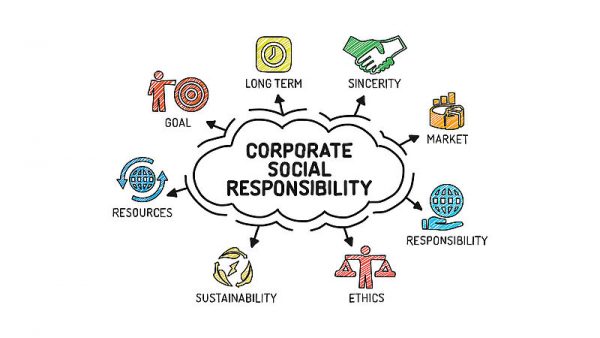
Like it or not, and irrespective of our personal political ideologies, corporate social responsibility has gained in popularity in the past decade. In this article, we’ll discuss what Corporate Social Responsibility (CSR) is and what it means for private business owners from an exit strategy perspective.

The Four Pillars of CSR

CSR is often thought of as having four pillars: the community, the environment, the marketplace and the workplace.

  1. Community. This pillar refers to the manner in which a company contributes to the greater community. Contributions can range from simply providing good jobs for people in your local community to donating money for a new playground or public art project.
  2. Environment. People around the globe are becoming more environmentally conscious. Increasingly, consumers want to know that the companies that they patronize have sound environmental practices. These practices range from recycling, to using low-emission high-mileage vehicles, to using biodegradable packaging. The more your company can demonstrate how it is protecting the long-term health of our environment, the more customers will be attracted to your product or service.
  3. Marketplace. Proper corporate social responsibility includes adopting fair treatment policies towards suppliers and vendors, contractors and shareholders. It’s critical to view all stakeholders in the company as partners. The marketplace aspect of CSR means rejecting any exploitative business practices that you may have in favor of fairer and more equitable business practices.
  4. Workplace. With respect to workplace, CSR encourages the implementation of fair and equitable treatment of employees. It makes sense that having a healthy, financially secure and committed workforce with a strong corporate culture and a safe work environment improves the desirability of your company. Profit sharing, medical coverage, retirement and wellness programs are all part of this mix.

Are socially-responsible companies better investments?

In my experience as an M&A advisor, I have to answer yes, all other things being equal. It’s not the most important factor, but today’s acquirers prefer to buy companies with a culture of social responsibility. Owners considering selling or recapitalizing should plan for this. Being able to demonstrate a strong CSR track record should serve to increase buyer and investor demand and therefore selling price.

Our M&A advisors to small businesses have noticed that older (baby boomer) owners in particular are surprised by the importance of good CSR practices to the younger generation of buyers. With the advent of social media, its easier than ever for them to get a sense of your company’s social responsibility.

It may be time to to gather your management team to explore the value that CSR can bring to your organization and assess your CSR performance. Here is an HBS white paper on Why Every Company Needs a CSR Strategy and How to Build It.

*          *          *

Al Statz is Exit Strategies Group’s founder and CEO. For further information or to discuss a current need, confidentially, Al can be reached at 707-781-8580.

Consider Your Options When Selling a Business with Real Estate

Al StatzWe often get asked how owning a facility (versus leasing one) affects the sale of a company, so I dug through our 17 years of business sale transactions involving seller-owned real estate to look for patterns. And the archives didn’t disappoint. I found five common deal scenarios that shed light on this question.

But first, here’s the short answer. Owning your real property is likely to increase the demand, transferability and selling price of your business. Why? When you control the property, you can offer business buyers more options. Now let’s discuss the scenarios …

5 Real Estate Options Available to Business Owners Upon Exit

Option 1:  Lease and hold the real estate

This is a popular choice with seller clients who want a source of retirement income and will soon have more time to manage investments. They are comfortable leasing and managing a property that they know well, and they believe in the tenant (their business!). If they decide to sell the property in the future, they will likely have a ready buyer. (In a few cases the decision to hold was necessitated by poor tax planning by clients and their CPAs.  Don’t let that happen to you.) When a business is location dependent, astute buyers will want a long term lease. Without one, they probably won’t pay as much for the business or get financing for the purchase.  Leasing also reduces a buyer’s cash needs, which expands the pool of potential buyers for your company.

Option 2:  Sell the real estate in a concurrent transaction

Buyers like to own real estate for the same reason our seller clients do—they see it as a good long term investment. Selling is popular with our clients who want to reinvest in a property or real estate partnership with higher returns, less risk or fewer management headaches, often through a 1031 exchange. Or, they just need or want the cash. This scenario is almost always preferred by both parties when a property has specialized improvements (think nursing home, winery, self-storage) or when relocating the business is risky (think preschool, retail). Buyers will generally pay more for enterprise goodwill (a.k.a going concern value) when they can own and control the underlying property. And sellers usually don’t want to hold onto a special use property because if the buyer fails, they could be stuck without a tenant for quite a while.

Option 3: Lease the real estate with an option to purchase

Sometimes a buyer is cash limited or wants to use the cash available to grow the business. Or, maybe the cash flows don’t support bank financing and the seller has immediate cash needs and can’t finance. Or perhaps business conditions are such that the buyer needs time to decide whether to keep the business in that location. In scenarios like these the best option for the real estate may be a lease with an option to purchase. Sellers can enjoy a few years rental income while the buyer builds cash reserves or stabilizes business performance to the point where banks are willing to lend. Lease-options can be structured in many different ways to align the interests of the parties.

Option 4: Lease the property, then sell it separately as a leased investment

Some business buyers don’t want to own real estate. In my experience, most public and larger private corporations and private equity buyers prefer being able to deduct an entire lease payment rather than just the interest portion of a mortgage payment. For our seller clients, who are looking at a short-term hold, getting the lease terms right is critical. Buyers of leased investments are usually sophisticated investors who are easily turned off by non-market terms. We advise sellers to make the new tenant (the business buyer) aware that they plan to sell the property so that the tenant is happy and cooperative when the property goes on the market.

Option 5: Sell the business, then sell the property, unoccupied and unleased

Our seller clients sometimes go this route to maximize total value when the highest and best use of their property is no longer the existing business use. Sometimes their business has simply outgrown the property. In strategic acquisitions and mergers, facilities are often redundant or sub-optimal and therefore not purchased. I hate to say it, but we’ve sold several California manufacturing and distribution businesses to buyers that rented our client’s facility for a few months until they could transfer operations out of state.  The beauty of this option for sellers is that they will now be able to expose the real property to a broader pool of potential buyers, including owner-users and re-developers.

Exit Strategies only sells real estate when packaged with a business. After selling businesses under options 4 and 5, we refer clients to commercial brokers with better access to private and institutional net-lease investors or owner-occupied buyers.

Other Common Questions

  • Owners of small businesses often ask, should I sell the property first?  The answer is almost always no. As a rule, commercial properties are more marketable than small businesses. For most commercial and industrial properties this holds true with or without a tenant.
  • When maximizing value is a seller’s primary objective, their first question should be, is the total value of my business and property higher if I sell them as a package or sell them separately? Every situation has to be evaluated on its own merits.

I’ll finish with a quick story …

A number of years ago we sold a B2B distribution business in a volatile low-margin industry. Our client’s preferred option was to hold and lease the property for retirement income, but he was also open to  selling and reinvesting the proceeds in another property. I should mention that the current use of the property was the highest and best use. After several months on the market we had only one strong offer for the company, and that buyer insisted on purchasing the real estate as well. We negotiated a package deal that maximized total value to our seller client. During the negotiation we connected our client with a commercial broker who specialized in leased investments. After closing, our client happily 1031 exchanged into a commercial property with national tenants and professional management. He was also able to diversify his real estate holdings outside of California. The moral is, it is good to be able to offer options.

If you own a business with real estate, plan ahead and involve an M&A advisor/broker for best results. And be flexible. The deal you envision may not be the best deal the market has to offer.

• • •

Exit Strategies Group, Inc. is an M&A brokerage and business valuation services firm serving closely-held businesses from offices in California and Portland Oregon.  Al Statz can be reached at 707-781-8580 or alstatz@exitstrategiesgroup.com.

Why Business Owners Should Prepare to Sell Now


Al StatzReason 1:  Concentration of Wealth

A typical business owner has 70-80% of their wealth tied up in their business. That’s a lot of eggs to carry in one basket. On top of that, private businesses are less liquid and more risky than stocks, bonds and real estate investments.

Fortunately owners can control the value and sell-ability of their businesses. Now, whether they exercise that control is another matter!

Reason 2: Many Sales Are Unplanned

Over the years, studies have indicated that as many as 50% of all business sales are involuntary.  The cause may be personal in nature (death, disability, divorce, etc.), or related to a change in business or market conditions. If that 50% statistic is close to accurate, owners should make their businesses ready to sell and attractive to investors at all times. Definitely as they approach retirement age.

So, how sale-ready are most businesses?

In the Q1 2019 Market Pulse Survey of U.S. business brokers and M&A advisors by the Pepperdine Capital Markets Project of Pepperdine University, the consensus was that 70% of businesses are unsellable. These same professional intermediaries also estimated that 48% of businesses on the market won’t sell.  Now that’s a sobering statistic.

The quarterly Market Pulse Survey looks at businesses in the range of $500,000 to $50 million in enterprise value. Generally, larger businesses are more sell-able. This size effect has always been there, but in my experience it has become even more pronounced since the 2009-2010 recession.

Are business owners planning ahead?

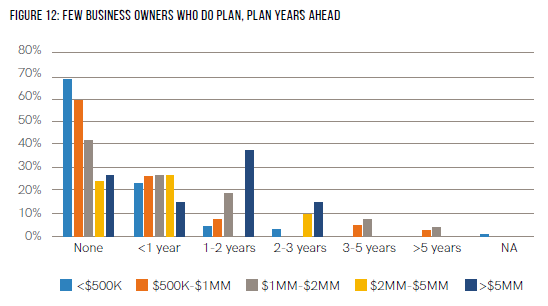
The intermediaries surveyed by Pepperdine in Q2 2019 indicated that most business owners conducted no formal planning prior to engaging a broker/advisor. Lower middle market business owners ($5-50 million enterprise value) were more proactive, though still roughly 40% failed to plan more than a year in advance.

Why owners may be resisting exit preparation.

From my perspective, some of the more common reasons business owners put off exit preparation are their independent personalities, blindspots caused by a lack of experience and objectivity, fear of looking foolish, skepticism (too many impostors and bad actors out there), the formality of the processes that have been proposed to them, and just being too busy working in their businesses.

The best way to maximize enterprise value and increase the likelihood of a successful ownership transition is to start preparing early. Don’t leave it to chance. For more information see my recent blog titled, Failing to Plan Your Exit is Planning to Fail. Or visit this page of our website for an overview of the exit planning process.

*          *          *

Al Statz is founder and president of Exit Strategies Group, a leading M&A advisory and business valuation firm with offices in California and Portland Oregon. Al can be reached at 707-781-8580 or alstatz@exitstrategiesgroup.com. Feel free to request a copy of the latest Market Pulse Survey.

Failing to Plan Your Exit is Planning to Fail

Al StatzBen Franklin is credited with saying, “If you fail to plan, you are planning to fail.” And Warren Buffet once said, “Someone’s sitting in the shade today because someone planted a tree a long time ago.” These sayings are great reminders for business owners looking to exit.

For most business owners, their company represents the lion’s share of their net worth. It also represents their life’s work and a legacy worth protecting. Getting their exit right takes some planning.

However, coordinating all of the business, management, financial, legal, tax, estate, family, legacy, market and personal considerations is complicated and emotional for owners. And few have the time (or the training) to tackle all of this on their own, while running their business. Therefore many owners procrastinate when it comes to exit planning.

Failing to Plan

Failing to prepare for an exit can result in a business owner …

  • being forced by unplanned circumstances to exit involuntarily in a bargain sale, sale to a competitor or liquidation
  • wasting time and money on one or more sale transactions that fail to close
  • undervaluing their business
  • giving up more of the proceeds in taxes than necessary
  • prolonging retirement and failing to achieve their retirement goals
  • failing to leave a lasting legacy
  • burdening their family with matters that they were unprepared for

Whether you intend to transfer your company to family, partners, managers, a third party, private equity or a strategic buyer, exit planning is well worth it.

Eight Benefits of Exit Planning

  1. Identifies value and transferability gaps – a key starting point
  2. Makes your company more attractive to buyers
  3. Increases value for all shareholders
  4. Produces a smoother management transition
  5. Minimizes risks
  6. Minimizes taxes
  7. Establishes clear priorities, strategies and time frame
  8. Prevents costly mistakes

On a personal level, exit planning settles your mind and re-energizes you by focusing your efforts and giving your work greater purpose.

Fortunately, you don’t have to learn the ins and outs of exit planning. This is where firms like Exit Strategies come in.


Contact Al Statz at 707-781-8580 or email alstatz@existrategiesgroup.com for more information on simple and straightforward business preparation. We can help you create a plan, and coordinate with and introduce you to the other professionals you’ll need. As always, everything we discuss will remain confidential.

Opportunity Zones: a Compelling Tax-Advantaged Investment for Business Sellers

Cashing in on the sale of your business is the final reward for many years of dedication and hard work. Then your CPA tells you how much you will owe in taxes. It’s a shock, but there’s a relatively new reinvestment opportunity that may help trim your tax bill …

In April 2018, The U.S. Department of the Treasury and the Internal Revenue Service (IRS) designated Opportunity Zones in 18 States. The Tax Cuts and Jobs Act created Opportunity Zones to spur investment in distressed communities throughout the country. New investments in Opportunity Zones can receive preferential tax treatment.

Under the Tax Cuts and Jobs Act, States, D.C., and U.S. possessions nominate low-income communities to be designated as Qualified Opportunity Zones, which are eligible for the tax benefit. Attracting needed private investment into these low-income communities will lead to their economic revitalization, and ensure economic growth is experienced throughout the nation,” said Secretary Steven T. Mnuchin. “The Administration will continue working with States and the private sector to encourage investment and development in Opportunity Zones and other economically disadvantaged areas and boost economic growth and job creation.”

Qualified Opportunity Zones retain this designation for 10 years. Investors can defer tax on any prior gains until no later than December 31, 2026, so long as the gain is reinvested in a Qualified Opportunity Fund, an investment vehicle organized to make investments in Qualified Opportunity Zones. In addition, if the investor holds the investment in the Opportunity Fund for at least ten years, the investor would be eligible for an increase in its basis equal to the fair market value of the investment on the date that it is sold.

How Opportunity Zone Funds work

An investor who has triggered a capital gain by selling a business or real estate, can receive special tax benefits if they roll that gain into an Opportunity Fund within 180-days. Advantages are:

  • The payment of capital gains is deferred until December 31, 2026
  • It reduces the tax owed by up to 15% after 7-years
  • There is zero tax on gains earned from the Opportunity Zone Fund

If you’re planning to realize a sizeable capital gain or recently sold an asset where there is a capital gain (within the 180-day filing window), Opportunity Funds may help to keep more in your bank account and less in the federal treasury. It’s worth a look. Consult with your CPA or financial advisor.

Bob Altieri is a senior M&A advisor and business valuation expert with Exit Strategies Group. He can be reached at boba@exitstrategiesgroup.com.

California’s AB5 Law May Impact Small Business Values

Adam Wiskind, CBIAssembly Bill 5 (AB5), signed into law last month by governor Gavin Newsom, will impact the valuation of many small businesses in California that have grown to depend on independent contractors.  For impacted owners intending to sell in the near term, this new law may require a change of plan.

The new law, which goes into effect on January 1, 2020, creates an explicit three-part test for whether a worker can be classified as an independent contractor.  A worker can only be considered an independent contractor if:

  • (A) the worker is free from the control and direction of the hiring entity in connection with the performance of the work, both under the contract for the performance of the work and in fact; and
  • (B) the worker performs work that is outside the usual course of the hiring entity’s business; and
  • (C) the worker is customarily engaged in an independently established trade, occupation, or business of the same nature as the work performed.

AB5 exempts many occupations including doctors, dentists, lawyers, engineers, architects, accountants, real estate agents, travel agents, graphic designers, human resources administrators, grant writers, marketers, fine artists, investment advisors, broker-dealers and salespeople provided their pay is based on actual sales, rather than wholesale purchases or referrals. However, many small businesses in California that regularly employ independent contractors for work that is within the usual course of their business are not exempt.  For these businesses reclassifying workers could add as much as 30% to labor costs.  Labor intensive service businesses will be most impacted. Court reporting, janitorial and delivery services are typical examples.

Valuation Impact

Non-exempt California businesses that have to reclassify independent contractors to employees will likely see a contraction in enterprise value as buyers (and banks and appraisers) apply the expected increase in labor cost to proforma financials and guess at how much of the increased cost can be passed along to consumers. As businesses in a particular non-exempt industry convert from independent contractors to employees, the competitive playing field will be re-balanced.  Some who choose not to comply will go out of business. Those who already comply could see an increase in business, and value.

Owner Options

Business owners are considering their options to respond to the new law and its impact on valuation, including:

  1. Mount legal or policy challenges – The major gig-economy platform companies will challenge the law and small businesses may follow suit.
  2. Relocate work outside California – Can work currently being done by local independent contractors be transferred to contractors outside of California?
  3. Ignore the law – Some owners will no doubt continue with business as usual in the hopes that they don’t face a legal challenge.
  4. Reclassify workers and absorb the additional costs – The new law will raise costs for those who reclassify workers, and likely for the consumers of their products and services. There is a lot to consider here.  Which workers should be reclassified?  How will worker roles change? What are the cost implications?  How will these changes impact supervision, accounting, compliance and insurance requirements? Will the change result in a more committed and productive work force?

Regardless of how they respond, business owners who have spent years building their businesses under an independent contractor model and are impacted by AB5 are at crossroad. Hopefully this article raises awareness of the issues and helps some owners evaluate their options. If you are one of these owners, be sure to get professional legal and HR counsel.

Adam Wiskind is an M&A advisor at Exit Strategies Group and is a Certified Business Intermediary based in Sonoma County California.  If you are interested in better understanding this topic or in selling a $1-50 million revenue California business, contact Adam at awiskind@exitstrategiesgroup.com.