Request a Strategy Call and we will get in touch with you
Will appear on Seller pages – RECENT SELLER ARTICLES
Ingredients of a Successful Business Sale
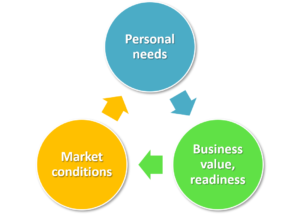
Going to market when you and your business are ready to sell and market conditions are right provides the best opportunity to maximize results. Let’s look at how these three ingredients combine:- You, the Owner

- The Business itself
- The Market
Are you and your business prepared to sell?
- What is the company’s probable selling price in today’s market?
- Are value drivers and detractors clearly identified?
- How do marketability, goodwill transferability, due diligence survivability, and deal finance-ability measure up?
- Who are the most likely buyers and what deal terms are you likely to see?
- Is cash flow being optimized at this time?
- Does management have good visibility and a clear runway?
- Are you on top of major industry and market trends?
- Will net sale proceeds be sufficient to support your (family’s) desired life style?
- How will your proceeds be reinvested?
- Are you ready for life after business? What are your personal plans?
- Are you prepared to assist in a smooth ownership transition?
- What steps can be taken now to minimize taxes and reduce risk at deal time?
- Is the management team sufficiently committed to the future success of the company?
- Are key employee incentives in place to support a sale?
- Are leases and contracts assignable and attractive to a buyer?
- Is intellectual property properly titled, protected and transferable?
- Are all books and records in good order?
Plan ahead, or plan for less
Is your company an add-on candidate?
Most business acquisitions by private equity firms have been “add-on” deals lately.How Big of a Concern is Confidentiality in Business Sales?

Small Business Transactions Up 18%, Sellers Earn Higher Sale Prices – According to Industry Report
- The number of closed transactions in Q3 represented both a 17.9 percent increase from last year and the highest number of small business sales recorded in a third quarter since BizBuySell began tracking data in 2007.
- The median sale price for businesses sold in Q3 rose 5 percent compared to last year.
- The average cash flow multiple jumped nearly 9 percent.
- Service-related businesses led the way with a 17 percent increase in closed transactions, while manufacturing was up 16.2 percent and restaurants were up 13.3 percent compared to last year
- In addition to an increased number of closed sales in Q3, there was also a growing number of businesses offered for sale.
- 2014 remains on pace to record the highest number of closed transactions reported since the BizBuySell Insight Report’s inception in 2007.
A Sample Acquisition Due Diligence Checklist
In privately-held business acquisition transactions, as soon as a letter of intent or contingent purchase agreement has been negotiated, the buyer’s in-depth due diligence begins. To kick-start this phase of the transaction, the buyer requests from the seller all of the information that they need to conduct their investigations. Once the buyer is satisfied, the transaction proceeds to the closing phase.
Download Sample Small Business Acquisition Due Diligence Request List
This sample buyer due diligence checklist is a generic list for the acquisition of a small privately-held business. It is for information purposes only. Some of the items listed will not apply to your specific business acquisition and other critical requests will be missing. Please do not use this as an actual request list!
I can’t overstate how important it is to obtain competent legal, financial, tax and other specialized counsel to assist with your due diligence investigations and requests for information. A skilled M&A broker can organize and manage the due diligence process to keep the transaction participants in sync and the deal on track. Often, the broker sets up a virtual data room to which the seller team can upload due diligence documents and from which the buyer team can view and download.
Due diligence is a critical step in every business acquisition. For more information about the due diligence process when selling, merging or acquiring a California business, you can reach Al Statz at 707-781-8580 or alstatz@exitstrategiesgroup.com.
You’re ready to sell. Is your business?
- Create a recurring revenue model. Businesses that have a recurring revenue model are easier to sell than those where new revenue sources (i.e., customers) must continuously be found. I agree completely.
- Become a passive owner. Get yourself out of the day-to-day operations as much as possible to increase value to potential buyers. If you are no longer deemed essential to the success of the business, a buyer can more easily see themselves being successful after the sale. In my experience, becoming entirely passive is a lofty goal for most small businesses, but you can make yourself less critical if you focus on this years ahead of a sale.
- Consider who the right type of buyer might be. Is it a competitor, an individual investor/operator, a private equity group, a public company, etc. You will need to produce all the information needed by potential buyers. Different types of buyers need more of certain types of information. You also need to determine what information is truly “sensitive” and develop ways to protect it in the sale process, especially when the buyer is a competitor. Experienced business brokers and M&A advisers are expert at this.
Escrows in California Business Sale Transactions
Business “Transaction Escrows” protect the interests of buyers and sellers, and are used extensively by transaction attorneys and brokers in California. Then there is what’s called a “Holdback Escrow” which secures post-closing obligations and adjustments. This blog introduces you to both types of escrows and how they facilitate business deals.
What is a Business Transaction Escrow?
In California, for business sale-purchase transactions of all sizes and shapes, it is common to have an escrow agent serve as a neutral holder of funds and documents, communications link and closing facilitator. The escrow agent also deals with regulatory compliance, prepares routine transaction documents and closing statements, and handles administrative details in a cost-effective manner.
Business escrow companies in California are either attorneys (acting in a neutral capacity) or they are licensed by the California Department of Corporations. Due to the specialized nature of business escrows, the number of providers is considerably smaller than those serving real estate transactions.
How it Works
Escrow starts with a written agreement between the buyer, seller and escrow holder. The escrow holder prepares written escrow instructions* that reflect the terms of the purchase agreement and all conditions of the transaction. The buyer and seller will sign the escrow instructions, and make any necessary earnest money deposits. The escrow holder will process the escrow in accordance with the instructions. When all conditions are met or achieved, the escrow will be “closed”. The escrow holder provides a concise accounting of all funds, and arranges for the safe delivery of all funds and documents to their proper recipients.
* When applicable, these instructions will include a Notice to Creditors of Bulk Sale. California’s Bulk Sale law is contained in Commercial Code Section 6101-6111.
The typical duties of an escrow holder in a business asset sale/purchase transaction include:
- Requesting publication, recording and UCC lien searches for state and county
- Complying with Bulk Sale statutes (publication), as applicable
- Notifying the county tax collector
- Requesting a beneficiary’s statement if debt or financial obligations are to be taken over by the Buyer
- Requesting demands from existing lien-holders, receiving claims
- Notifying and obtaining clearances from County, State and Federal agencies as required
- Complying with lender’s requirements, securing loan documents and receiving funds
- Obtaining and holding purchase funds from the buyer
- Prorating taxes, interest, rents, security deposits, etc., as instructed
- Preparing routine legal and financial documents such as notes, security agreements, personal guarantees, amortization schedules, deeds of trust, UCC-1 financing statements, bill of sale, corporate resolution authorizing the transaction, etc.
- Can prepare fictitious business name statements
- May prepare routine amendments to agreements
- Securing releases of all contingencies or other conditions imposed on the particular escrow
- Preparing estimated closing statements prior to close of escrow
- Consultation regarding problems that arise
- Preparing final closing statements for the parties, accounting for the disposition of all funds deposited in escrow
- Obtaining appropriate signatures on all documents
- Close escrow when all instructions of buyer and seller have been carried out
- Disbursing funds as authorized by instructions, including commissions and payoff liens
- Preparing and recording UCC-1, UCC-3 and deeds of trust, as needed
- Securing tax clearances
- Distributing final transaction documents to all parties
The above list is a generic set of escrow tasks in a sale of business assets. The escrow tasks performed in an actual transaction will depend on the transaction type and circumstances, and will be listed in the instructions prepared by the escrow holder. Stock sale escrows look a lot different, and are typically simpler.
The Holdback Escrow and How it Works
No. In some Merger and Acquisitions (“M&A”) transactions, the buyer and seller agree to place a portion of the purchase price in a third party escrow account for a specified period of time after closing. These funds are intended to secure payment to indemnify the buyer against losses caused by a breach of the seller’s representations, warranties or covenants; for payment of post-closing working capital or balance sheet adjustments; to guaranty payment of an earn out (where part of the purchase price is based on post-closing performance of the business), as collateral to insure the performance of some other event by the seller; or some combination of these. Holdback escrows go by other names, such as “retention escrow”, “indemnity escrow” and “holding escrow”.
Both buyers and sellers can benefit from holding back funds in escrow. Holdback provisions should be carefully thought out and negotiated early in the M&A negotiation process. Understanding the typical approaches and common pitfalls is extremely helpful, which only comes with experience.
Holdback escrows are often completely separate from the transaction escrow. The escrow holder may be a bank, trust company, or other professional service provider. Typically, funds from the transaction escrow roll over into the holdback escrow immediately after a transaction closing. A holdback escrow requires a separate agreement between the escrow agent, buyer and seller, which includes, among other things, conditions for releasing funds and procedures for resolving any disputes. This can take some time to negotiate.
If you have questions regarding this blog post or need help selling or acquiring a California company, you can Email Al Statz or call him at 707-778-2040. And if we don’t know the answer we would be happy to direct you to someone who does!
Please don’t tell me liquidation is my best exit option!
While the typical premise of value in valuing an operating business for a sale/acquisition or exit planning is as a going concern, occasionally, facts and circumstances indicate that an owner would be better off liquidating his or her business. Unfortunately, this often comes as a shock to an owner who has spent years working in and building a business with the expectation that it can be sold for enough to provide a significant nest egg for retirement.Be Prepared!
“Be Prepared” is the Boy Scout Motto that has served young individuals and their character development in over two hundred countries since 1907. It can also be an effective mantra for a business owner who will engage in marketing and selling a business. A well prepared business owner plays a vital role on the transaction team and helps ensure maximum value to the shareholders and a smooth transition of ownership.