
Can I Sell My Business (C Corp Stock) Tax Free?

In some cases yes!  Congress has long recognized that small businesses investment is an important driver of the U.S. economy.  Back in 1993, to encourage capital investment in small businesses, they created a rule that eliminates federal income tax on some (later revised to all) of the gain on the sale of certain C Corporation stock issued after August 10, 1993. This article introduces the Qualified Small Business Stock (“QSBS”) tax break for business owners who are contemplating a future sale.

QSBS Requirements

To qualify for this tax break, your stock has to be deemed Qualified Small Business Stock per Internal Revenue Code Sec. 1202. Here’s a summary of 1202’s requirements:

  1. The business must be a domestic C Corporation
  2. Is a small business, defined as assets of less than $50 million
  3. The stock was issued after 8/10/1993*
  4. The stock was acquired at original issuance
  5. The stock has been held for 5 years or more at the time of sale
  6. The business is NOT engaged in professional services that are dependent on the reputation or skill of one or more employees, financial services, farming, mining or resource extraction, hotels, restaurants or other similar businesses

*Depending on the issue date of the stock, 50%, 75% or 100% of the gain (up to $10 million) may be excluded from federal income tax. The gain exclusion is 50% (subject to a 7% Alternative Minimum Tax (“AMT”) add-back) for stock acquired between August 11, 1993 and February 17, 2009. Stock acquired between February 18, 2009 and September 27, 2010 is eligible for 75% gain exclusion (subject to 7% AMT add-back), and stock acquired after September 27, 2010 receives a 100% exclusion, without an AMT add-back.

Andersen Tax offers a more complete list of QSBS requirements.

The QSBS tax break was made permanent by the PATH Act (Protecting Americans from Tax Hikes Act) of 2015. In case you’re wondering, the recent Tax Cuts and Jobs Act of 2017 did not alter QSBS rules, but the reduction of the federal corporate tax rate to 21% affects the magnitude of the QSBS benefit relative to a sale of assets. It is my understanding that California’s Franchise Tax Board no longer allows an exclusion on the gain of QSBS.

M&A Perspective

When a C corporation sells its assets rather than its stock, Sec. 1202 doesn’t exclude the gains that occur inside the corporation. So, even if you hold QSBS stock, you may not be able to get off tax free.

Acquirers of private businesses generally prefer to buy assets, not stock. For buyers, buying assets reduces their future tax bills, improves their cash flow, and reduces potential legal liabilities. When asked to buy stock and forgo these benefits, buyers usually expect to negotiate a meaningful price discount. However, given the magnitude of the QSBS tax break, especially when eligible for 100% exclusion, a seller of QSBS could give a buyer a significant price discount and still come out well ahead (relative to selling assets).

Fortunately, the reduction in the corporate tax rate to a flat 21% under the Tax Cuts and Jobs Act of 2017 makes a C Corp asset sale more palatable. The corporation will have to pay 21% on the gains, but the shareholder, when they receive the remaining sale proceeds through a liquidating dividend, can use Sec. 1202 to avoid tax on that cash. The overall tax effect is closer to that of an asset sale by an S Corp or LLC.

Do you have QSBS?

The prospect of selling qualified small business stock is compelling; however determining whether your C-Corp stock qualifies as QSBS and claiming this benefit can be tricky.  Work with a CPA or tax advisor who is well-versed in QSBS requirements and who can calculate and compare your after tax proceeds under various deal structures. For another slick C-Corp tax maneuver, see my blog on personal goodwill.

If you intend to sell your business some day, please be aware that tax minimization strategies can have a big impact on how much money goes into your pocket. Some strategies can take 5 years to implement, so get your M&A and tax advisor involved early on.

*  *  *

Exit Strategies Group’s M&A advisors are dedicated to staying abreast of tax minimization strategies for our business sale, merger and acquisition clients.  Al Statz, founder and CEO of Exit Strategies Group, is based in Sonoma County California and works with lower middle market companies throughout the U.S.  For further information on this subject or to discuss selling a company, contact Al at alstatz@exitstrategiesgroup.com or 707-781-8580.


May 10th Seminar: How to maximize the value of your business upon exit.

Are you starting to think about retirement, but don’t know how best to transition out of your business? Consider attending a free breakfast seminar hosted by Exit Strategies Group and Exchange Bank on how to maximize the value of your business upon exit.

  1. This 1-1/2 hour seminar will answer the following questions:
  2. What are the value drivers that determine how much my company is worth?
  3. What can I do to prepare my company for sale? What should I not do?
  4. What are the steps in the sales process?
  5. What is the current state of the business sales market?
  6. What criteria does a bank use to qualify my business for a bank loan?
  7. How do I maximize the proceeds from the sale of my business?

The Details

May 10th, 2018 7:30 am to 9:00 am in Santa Rosa. A continental breakfast will be provided.

Space is limited.  For your privacy, only one company per industry will be allowed to attend. To reserve a spot, RSVP to Adam Wiskind, awiskind@exitstrategiesgroup.com or call (707) 781-8744.

About the Sponsors

Exchange Bank was the #1 Community Bank SBA Lender in Sonoma County in 2017, and is a Preferred SBA Lender and a Top Ranked SBA Lender in the San Francisco District/Greater Bay Area.

Exit Strategies Group is a full-service mergers and acquisition brokerage firm serving private companies with $1-50 million in revenue. Exit Strategies also offers expert business valuation services for many reasons including exit planning, buy-sell agreements and litigation opinions.

If you are unable to attend but would like information on maximizing the value of your business, please contact Adam.

How Do I Sell My Personal Goodwill?

The concept of goodwill in a business sale is familiar to most business owners. The more the better, right? Personal goodwill (versus enterprise goodwill) on the other hand is less familiar, and trickier to deal with. If your company is structured as a C-Corporation, you should know about personal goodwill and how its existence could put more money in your pocket when it’s time to sell. Here’s how this works.

The C-Corp Dilemma

Sellers of C-Corps prefer to sell the stock of their companies because it is more tax efficient than selling assets; yet the reality is that most business sales are structured as asset transactions. Why? Because, for buyers, buying assets reduces their tax bill, improves their cash flow, and reduces potential legal liabilities. Astute buyers that are asked to forgo these important benefits (i.e. when they are asked to buy stock) will expect a substantial price discount. Some will just walk away.

With an S-Corp on the other hand, which is a pass-through entity, selling assets (vs. stock) usually isn’t a much of problem from a tax perspective. In some cases, selling assets can even be to a seller’s advantage.

But for C-Corps, selling assets is a big disadvantage. Here’s a simple example. Assume that the combined federal and state C-Corp income tax rate is 29%, and that the combined individual capital gain tax rate is 28%. In an asset sale, for every $1.00 of transaction price (above book value of assets), C-Corp shareholders net only 51¢. Could this happen to you?


Exit Planning Tip:  

If you own a C-Corp and your expected holding period is 5 years or more, talk to your CPA about electing S-Corp status so that you can avoid the possibility of being double taxed when you sell.


Does the Goodwill Go Home at Night?

Goodwill value is that portion of a business purchase price that exceeds net tangible asset value. Personal goodwill (“PGW” for short) differs from enterprise goodwill in that PGW represents the value of an owner’s personal service to that enterprise, and is considered an asset owned by that person, not the business. PGW value is usually the result of an individual’s outstanding reputation and close personal relationships with customers or suppliers, or exceptional rainmaking or technical mastery, and other unique abilities that produce economic benefit for the business.

When PGW is present, the success and value of a business are largely dependent upon one or two individuals, usually the owner(s) in a small business. Without the key individual(s), the business may have little value. In other words, the goodwill goes home at night.

Personal Goodwill Presents a Tax Savings Opportunity

In asset sales of small owner-operated corporations, there can often be two sellers: (a) the business entity, and (b) an individual selling his or her personal goodwill. Selling PGW creates a tax savings opportunity for C-Corp owner-operators.

Using the same tax rates as above, for every $1 of purchase price that can be allocated to personal goodwill, the seller’s tax savings is 21¢. This is because the $1 allocated to PGW does not get taxed at the C-Corp level (is not “double taxed”). Suppose that in a $2 million transaction, $800K can be allocated to personal goodwill. This reallocation puts $168K more in the seller’s pocket.

NOT an Afterthought

Allocating part of the purchase price to personal goodwill has been an arrow in our quiver for the past decade or so; however, it cannot simply be a post-closing purchase price allocation. Rulings in multiple tax court cases demonstrate that PGW is under attack by the IRS.

When a C-Corp seller is considering allocating a portion of a purchase price to personal goodwill, these are some of the norms for supporting the existence of PGW apart from enterprise goodwill, and making it hold up to IRS scrutiny:

  1. There should be a separately negotiated PGW purchase agreement. As brokers, we plan for this with the seller and buyer, before an offer is made, and coordinate with the parties’ attorneys, CPA’s and lenders.
  2. The amount allocated to PGW should be based in economic reality. An independent personal goodwill valuation should be obtained to finalize the amount. This could cost $6-10k.
  3. There should be a significant and separately paid for covenant not to compete with the seller personally.
  4. The buyer should have a written employment/consulting agreement with the seller, for an extended term (say 18-24 months) with reasonable compensation. Otherwise, how could the seller’s PGW be transferred?

Selling any business with high personal goodwill is challenging. When goodwill goes home at night, valuation and marketability are generally reduced. Having a C-Corp structure adds yet another layer of difficulty and expense because of double taxation. Working with an experienced M&A broker, transaction attorney and CPA is extremely helpful when buying or selling this type of business.

Exit Strategies Group’s professionals dedicate themselves to staying abreast of tax strategies and potential pitfalls for private business owners as they plan and carry out business sale, merger and acquisition transactions. Don’t hesitate to call — the earlier we are involved the more impact we can have.

Al Statz is founder and President of Exit Strategies and is based in Sonoma County California. He can be reached at alstatz@exitstrategiesgroup.com or 707-781-8580.

What is my best exit option?

The answer to this question is different for every business owner depending on goals, facts and circumstances. When deciding the right way to exit business ownership, owners should understand and weigh all of their options. This article summarizes eight common exit options and their pros and cons. Some are more common than others. All options should be put on the table when selecting your exit path.

Eight Common Exit Options

  • Option 1.  Transfer to Family
  • Option 2.  Sell to Other Shareholders
  • Option 3.  Sell to Management
  • Option 4.  Sell to Employees using an ESOP
  • Option 5.  Sell to a Third Party
  • Option 6.  Recapitalize
  • Option 7.  Go Public
  • Option 8.  Liquidate

Click here to read the details.

Another option is to not exit ownership and scale back your hours, and either hire and retain capable managers to run the company for you, or milk the company to support your lifestyle while it naturally declines in profitability and value. For some businesses and some owners, this is a perfectly good exit strategy. In the end, you decide what’s best.

However, from my perspective having worked closely with business owners for a long time, the failure of many California business owners to adequately plan their exit often yields tragic results. Misinformation, procrastination and poor planning lead to missed legacy, wealth and retirement goals. Whereas, thoughtful preparation and implementation of an exit plan increases shareholder value and allows owners to exit on their own terms and time frame. The process can be fairly complicated and requires specialized expertise that few owners have.  If you want to exit your business in the next five years, now is the time to plan.

If you’d like help assessing your business and circumstances and creating an exit roadmap, or want help carrying out a sale or other exit option, connect with Exit Strategies’ president Al Statz at 707-781-8580 or email alstatz@exitstrategiesgroup.com.

Protect your Trade Name and Protect your Business Value

From my experience as an M&A Broker, I can tell you that your company’s trade name will be a valuable asset to most prospective buyers of your business.  Your trade name, which identifies your company’s brand and distinguishes its reputation with customers and suppliers, is worth strengthening and protecting if you plan to sell your company some day.

It may surprise you that the name of your business, even if it’s not officially registered, receives some legal protection as a trademark. Protection for unregistered marks is based on common law and the federal Lanham Act. Generally the first documented use of a trade name within a geographic area receives some measure of protection.

But the value of your trade name can be threatened if you don’t safeguard it. When a competitor starts to use a name similar to yours it can cause confusion in the market place and impact your business. For an asset as valuable as the name of your business, it’s wise to proactively protect it.

In California, any company doing business in the state under a fictitious name must register that name in the county where the business operates. Once registered, you as the owner will be able to sign contracts and engage in financial transactions under the fictitious name (also known as Doing Business As or DBA). California follows the first use rule when determining the ownership of a trademark. Fictitious name registration can also be useful to document how long you have been using your business name, in case it’s ever contested. However, fictitious business name registration does not necessarily protect your trade name throughout the state or in other states where you are doing business.

Registering your business’ name as a trademark at the state or federal level is the surest way to shelter it from unauthorized use and provide assurance to potential acquirers that they too would be able to benefit from the goodwill that the name generates.

The Secretary of State maintains the trademark registry for the State of California. Registering your trademark at the state level is generally easier and less expensive than a federal registration. However, there are some real benefits to registering through the United States Patent and Trademark Office. Federal registration is a more robust protection because it:

  • Makes it easier to bring infringement matters to federal courts
  • Increases remedies for trademark infringement
  • Has priority over state registration. If a federally registered trademark was in use before a state registered trademark, the federal registrant can stop the state trademark owner from using the mark. If the state mark was in use first, the mark’s use may be restricted to the state where it was registered.

Possibly the most attractive benefit of registering a trademark at the federal level is that after five years of not being challenged the trademark can become eligible for “incontestability”. Incontestable trademarks are, under normal circumstances, immune from being challenged.

To protect the value of your trade name (and your brand) it is worth considering federal trademark registration, especially if you plan to sell your business someday.
Most businesses also have an online presence. It is equally important (and in some cases far more so) to protect your trade name through marketing channels on the web and social media. At minimum you should acquire through Google or GoDaddy any domain names associated with your business.

Even if you don’t choose to utilize them, many owners will also want to claim their trade name and related monikers in Facebook, Instagram and other social media sites frequented by their clients. As with trademark registration, when you are looking to sell your business a prospective buyer will appreciate that you have diligently protected your business’ trade name and that you can transfer those protections as an asset of the sale.

For more information on protecting and maximizing the value of your business in a sale, email M&A broker Adam Wiskind at awiskind@exitstrategiesgroup.com or call 707-781-8744.

Please note that this article does not constitute legal advice on your situation! For legal advice, please contact an attorney with appropriate experience. If you need a referral to an attorney we would be happy to provide a recommendation.

Don’t Let Key Employees Hijack Your Exit Strategy

In building a successful company, owners usually invest in hiring and developing managers and key contributors that become vital to the company’s effective operations. These people are considered “key employees”. When the time comes for the owner to exit his or her business, these key employees are usually valuable “assets” in the eyes of potential buyers.  Unfortunately, if a business owner has failed to take certain steps, key employees can derail a successful sale or ownership transfer.

Here are some observations and suggestions with respect to key employees that can help enable a successful exit:

  • Ask all employees to sign a multi-year non-compete and non-solicitation agreement. While not always enforceable, they make employees pause and potential buyers more comfortable.
  • Ensure your key employees are sufficiently incentivized to facilitate rather than undermine your exit. For example, grant minority shares, stock options or stock appreciation rights, or offer them stay bonuses so they would profit from a sale.
  • Cross-train your key people to reduce reliance on single individuals. And if your business can afford it, develop a bench of qualified staff beneath key employees so someone can step up should an unexpected vacancy occur.
  • Carefully decide when and how much of your plans to divulge to key employees. Employees often react negatively to the prospect of a company being sold and may start seeking employment elsewhere. Assuming you’re planning to sell to a third party, most owners wait as long as possible to inform key employees of your plans, and, when you do, give them only the information they need. If possible, assure them they will be valued and wanted by the new owners. If the terms of the intended sale don’t allow you to do that, be ready to offer key employees a stay bonus that extends beyond the sale closing.
  • Involve an exit planning advisor who can help you position your company for a successful management transition. He or she can help you build transferable enterprise value, minimize key person risks and discounts, and avoid many common pitfalls along the way.

Click on this link to read a tragic key employee sabotage story:  When Key Employees Stall Your Exit

Could this happen to you? Don’t take chances with your retirement!

For further information on incentivizing key employees or for help with an exit strategy, M&A or business valuation, feel free to contact Jim Leonhard at 916-800-2716 or jhleonhard@exitstrategiesgroup.com.

Is Your Company an Employee Stock Ownership Plan (ESOP) Candidate?

Employee Stock Ownership Plans (ESOPs) have compelling competitive, financial and legacy benefits. For business owners weighing their exit options, a leveraged ESOP may be feasible if the owner, company and employees possess certain attributes:

Owner Attributes

  1. Owns 30% or more of corporate stock
  2. Has a low basis in the stock
  3. Looking to reduce involvement in the company long term (5+ years) or shorter term if successor(s) are in place to take over
  4. Concerned with employee welfare and wants to reward them by transferring an interest in company stock to them
  5. Wants to sell shares on a tax-deferred basis
  6. Willing to sell for fair market value and forgo the possibility of obtaining a price premium through an M&A sale process

Company / Employee Attributes

  1. Mature, non-cyclical business with strong operating performance (revenue and net margins), past and projected
  2. A balance sheet strong enough to absorb ESOP acquisition debt
  3. Adequate cash flow from operations to cover capital spending needs and debt service for ESOP acquisition and other borrowings
  4. Adequate payroll, say $1,000,000 or more per year
  5. 20+ employees
  6. A participatory management culture, and open and effective communications between employees and management
  7. Strong executive leadership and management bench to succeed long term

ESOPs are costly to set up and comply with IRS and DOL regulations. They are not for everyone. ESOP is a complex area that is not well understood by most CFO’s, attorneys, CPAs and M&A advisors. Be sure to work with specialists.

Use these rules of thumb if you are considering transferring ownership of your company through an Employee Stock Ownership Plan. To find help determining the feasibility of an ESOP for your California company, feel free to contact Al Statz at 707-781-8580 or alstatz@exitstrategiesgroup.com.

Does My Buy-Sell Agreement Establish Value for Estate Purposes?

Al StatzBuy-sell agreements that contain a clause that values stock at less than fair market value can be disregarded for tax purposes. It is important to consider the requirements of Internal Revenue Code (IRC) Section 2703 when developing an estate plan involving business interests in which 50% or more of the stock is family owned.
Section 2703(a) states that a shareholder agreement (entered into after October 8, 1990) that allows for the acquisition or transfer of property at a price that is less than fair market value will be ignored for estate and gift tax purposes. With respect to buy-sell agreements, Section 2703 provides that such agreements will set the value of shares for estate tax purposes if the agreement is binding in life as well as at death and results in the shares being transferred at fair market value.

Also, the buy-sell agreement must meet these requirements:

  1. It is a bona fide business arrangement.
  2. It is not a device to transfer property to members of the decedent’s family for less than full and adequate consideration.
  3. Its terms are comparable to similar arrangements entered into by persons in an arms­-length transaction.

A buy-sell agreement is deemed to meet the three requirements if more than 50% of the business enterprise is owned by individuals who are not members of the transferor’s family.

 A business owner’s estate plan and succession plan can be interrelated in other ways as well.  Exit Strategies does not provide tax counsel, but we connect owners with competent tax professionals.  Our accredited business valuation experts appraise privately held businesses and fractional interests for buy-sell, tax, exit planning and many other purposes.  Contact Al Statz at 707-781-8580 with any questions or to discuss a current need. 

How Would Your Company Survive Without You?

If you are like many business owners, you tend to get caught up in the daily demands of your business: managing sales and production, costs, and the bottom line. What about preservation and protection? Perish the thought, but what would happen to your company if it was unable to carry on due to your death or disability?

These concerns may seem like, and may in fact be, remote possibilities. However, by putting them off, you may be placing the future of your business, and its shareholders and their families, at risk. Once death or disability strikes, it will be too late to plan. Your company’s continuing operations could be severely damaged, permanently affecting your family, partners, employees, and others who may depend on it for their livelihood. If you’re like many business owners, you may assume that, if disaster struck, your family could simply sell the company. But, to whom would they sell and at what price? And what if otherwise capable buyers did not have sufficient cash for the purchase? A buy-sell agreement helps provide answers to these and many more questions.

What is a Buy-Sell Agreement?

Briefly, a buy-sell is a legal contract that guarantees a buyer for your business, and provides a means of funding the purchase. You typically negotiate a buy-sell with partners, shareholders, the management team, or key employees. The agreement commits them to buy out your share of the business if you die or become disabled. The process for valuing the company is agreed upon up-front, when the deal is struck. Life insurance and disability insurance are often used to provide the necessary funding.
Your family benefits by automatically having a cash buyer for the business. Your buyer benefits by being able to continue operations without fear of interference from outsiders who are unfamiliar with the business.

The Basics of Setting One Up

An insurance professional usually plays a key role in structuring a buy-sell. Ideally, your representative should have extensive experience in business succession planning. You may also require legal, tax, and accounting assistance, depending on the complexity of the agreement.
In many cases, funding a buy-sell agreement with both life and disability insurance may be the best way to proceed. The life insurance policy can either be term or have a cash value component. A term policy provides the largest death benefit for the least cost; however, it will only cover the buy-sell itself. If you want the insurance to provide other benefits, such as supplementing your pension or providing funds to buy out a partner, you will need a cash value policy. Disability insurance is particularly important, since the chances of becoming disabled are statistically greater than the chances of dying before age 65. However, insurability will depend on your occupation, health, and age.

One Company’s Approach

Consider the benefits of a buy-sell agreement, in the following hypothetical example. Barbara Smith, Mary Jones, and Tom Altuve are partners in a computer services company. Barbara owns the majority interest, while Mary and Tom are minority shareholders. Recognizing the importance of guaranteeing the company’s long-term survival, they consult an insurance professional, who, over the course of several months and with assistance from the company’s lawyers and accountants, develops a buy-sell agreement.

Twelve insurance policies are written to fund the buy-sell agreement, two life and two disability insurance policies per partner. Both life insurance policies are payable to the business. One policy will provide funds to buy out a deceased partner’s interest, while the other will pay the costs of recruiting a replacement. Of the two life policies, one is a term policy, while the other is a cash value policy. The cash value policy can be used to provide supplemental pension income in the event the partner retires. Of the two disability policies per partner, one is payable to the partner, while the other is payable to the company. The partner’s policy will provide him or her with income in the event of disability; the company’s policy will provide funds that can be used to buy out a disabled partner’s share.

Clearly, a buy-sell agreement can be complex and does not come cheaply, since it needs to be tailored to your company and your shareholders. However, it may help you sleep more easily at night, knowing that your family, and others who depend on your business, will continue to benefit from the company you worked so hard to build.

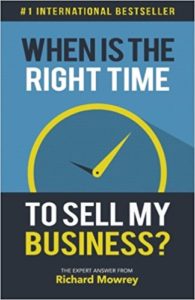
When is the Right Time to Sell My Business?

BOOK REVIEW —

I don’t recall the last time I recommended a book, but today I feel compelled to tell business owners about an excellent new book titled, “When is the Right Time to Sell My Business?”

This book not only helps you decide when to sell your business, but will also help you understand its value from the perspective of willing buyers, increase its value and marketability, and choose and plan your best exit option. If you are a private business owner; following the recommendations in this book will help you sell for more money, on your terms and time-frame, without regrets.

Expect a great return on the time you’ll invest in reading this book. Mr. Mowrey presents a sensible and proven approach to selling a business. It’s a quick read that covers a lot of important ground at just the right depth for busy business owners, and it’s one that I suspect you’ll take notes in and refer back to as you approach your exit. Mr. Mowrey pours a tremendous amount of valuable insights and sound recommendations into 188 pages. I can’t say that for most of the books on this subject authored by other so-called experts.

CPA’s, transaction attorneys, wealth managers, M&A intermediaries and business appraisers would also do well to read this one.

Purchase this Book on Amazon

Full Disclosure — Not only is Rich Mowrey a four-time business owner and seasoned valuation expert and transaction intermediary, he’s also a colleague of ours who we met through our national business valuation and M&A trade associations.

The process outlined in Rich’s book closely mirrors what Exit Strategies does for our clients. Feel free to contact one of our California-based advisors with any business valuation or M&A brokerage questions or needs.