
Do investment bankers, M&A advisors and business brokers actually add value? If so, how?
Financially savvy company owners, such as private equity groups and diversified public companies, clearly see the value that M&A advisors add, since virtually all of them hire one to run a professional sale process when selling a company in their portfolio — even when they know who the buyers are and which one is likely will pay the highest price.
On the other hand, most entrepreneurs only sell their company once. As a first time seller, they haven’t experienced the value that a capable M&A advisor adds, which puts them at a disadvantage. Fortunately a survey of business sellers by Fairfield University professor Dr. Michael McDonald¹ provides credible evidence that intermediaries add value and explains how. I’ve summarized some of the survey’s findings here.
Professor McDonald surveyed 85 business owners located across the U.S. who sold their companies with the help of investment bankers² for between $10 million and $250 million during the 2011 to 2016 period.
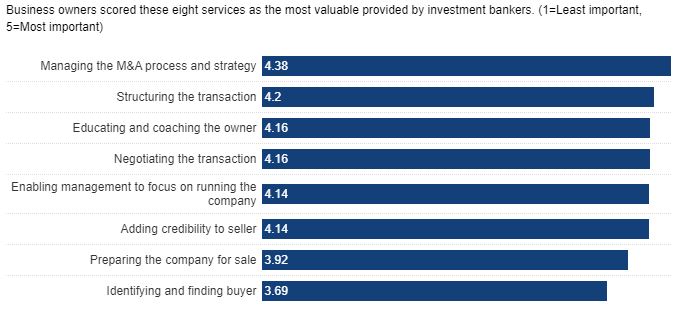
All 85 sellers answered YES to the question of whether their investment banker added value. As to where they added value, McDonald asked the owners to rate the value and relative importance of 8 services that such intermediaries provide:
- Identifying and finding the buyer
- Managing the M&A process and strategy
- Adding credibility to the seller
- Enabling management to focus on running the company during the sale process
- Educating and coaching the owners
- Negotiating the transaction
- Preparing the company for sale
- Structuring the transaction
All eight of these services added value according to the owners surveyed. They said the most valuable services were, “managing the M&A process & strategy”, “structuring the transaction”, and “educating and coaching the owner”.
Importantly, the least valuable service was “identifying and finding the buyer”. Simply introducing a buyer to a seller is not the primary value that intermediaries bring to the table (though clearly that is still a valuable part of the M&A process).
While this survey focused on $10-250 million deals, its findings hold true for smaller companies as well. If anything, the value that an experienced intermediary brings to owners of smaller businesses is even greater. These owners usually have even fewer internal resources to draw upon and are even more consumed with running their companies than their middle-market counterparts. Partnering with a quality business broker makes even more sense.
¹ I’m using the terms investment banker, M&A advisor, business broker, deal maker and transaction intermediary more or less interchangeably here. Firms that handle only $25 million plus deals usually refer to themselves as investment banks. Firms that mostly sell main street businesses for under $2 million usually call themselves business brokers. Exit Strategies mostly operates in the $2-50 million price range, and we’ve settled on calling ourselves M&A advisors. Some firms like ours prefer the term “boutique investment bank”, particularly if they serve a few niche industries. When hiring an intermediary, regardless of what they call themselves, it is important to have a good understanding of their knowledge and experience, and the level of service they provide.
² Download the full survey results: The_Value_of_Middle_Market_Investment_Bankers
For more information on Exit Strategies’ full-service sell-side M&A services or to discuss a current need, confidentially, you can reach Al Statz in our Sonoma County California office at 707-781-8580 or alstatz@exitstrategiesgroup.com.
 Recurring revenue, simply stated, is the portion of a company’s revenue that is highly likely to continue in the future. An effective recurring revenue model creates a “stickier” relationship between the provider of a product or service and the consumer. Those businesses don’t have to spend as much time and money acquiring new customers.


 With continuing growth in consumer online spending and many high-profile public acquisitions this year, it seems like a great time to sell your online retail business. But things are never quite as simple as they appear.