Assurance of business continuity is essential to most business acquisitions, and for small to mid-size companies, this often translates to retaining key employees. This blog looks at using a simple tool, called a stay bonus or retention bonus, to keep your key people on board through a sale or merger of your company.
Bonuses are commonly used in business to reward employees for performance, such as hitting a sales target, implementing a new system, or boosting manufacturing productivity. Bonuses can also be used to incentivize a key employee to stay with your company for a specified period of time after a sale or merger.
How much are we talking about here?
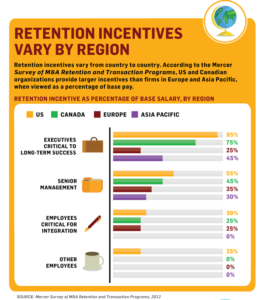 Stay bonus amounts are customarily based on the key person’s annual compensation, determined in accordance with the risk and effect of losing them. According to Mercer’s Survey of M&A Retention and Transaction Programs, median stay bonuses paid by U.S. companies range from 25 to 95 percent of base salary depending on the position (see graphic). The way we see this at Exit Strategies is that the stay bonus amount has to be personally meaningful to the key employee. In many of our deals this number is half to two-thirds of a person’s annual compensation.
But isn’t retention a buyer’s concern?
Remember that what gives your business value is the expectation of future earnings, adjusted for risk. As you reduce risk for buyers, your business value and probable selling price go up. From a buyer perspective, the cost of acquiring a business is more than just the purchase price. Other line items on their investment ledger include, for example, legal and professional transaction fees, loan fees and other closing costs, working capital injection (if you retain cash or AR) and any extra compensation paid to employees to ensure their continued employment and performance.
Stay bonuses can come from either side of the table—the seller or the company acquiring—or both. When retention bonuses are paid out of your proceeds, buyers can afford to pay a higher purchase price. So, in the end, it really doesn’t matter which side the bonus comes from.
When is the bonus offered?
Stay bonus agreements (a.k.a. stay-put agreements) are usually offered to (negotiated with) key employees when the owner is preparing to sell the company. Actual timing normally varies by employee and circumstances. Someone who you don’t identify as key to your company’s future may be offered a financial incentive during due diligence to ensure their participation in the short-term post-sale integration process. Integration bonuses are typically offered to CFOs, controllers or IT specialists.
Offering a stay bonus early on arises when an employee is critical to future performance and would be difficult to replace (e.g. a top design engineer or salesperson). Or when you need to involve them in the selling process. It may be compensation for the extra work involved. A third situation is when the employee is aware that you plan to sell the company, and you need them to stay put. When employees become aware that their employer is for sale, they understandably get nervous and may begin seeking alternative employment or become more open to offers of employment. When competitors find out that a company is for sale, key employees are likely to be approached and offered signing bonuses to jump ship. You can mitigate that risk by putting a retention bonus in place early on.
When is a stay bonus paid?
Stay bonuses should be paid out a specified number of months AFTER your deal has closed, not before and not at closing. Remember, you need them to stay on with the new owner. Most retention incentive bonuses are payable within 3 to 12 months after a deal closes. For key-employees who are critical to long-term success, it may be 24 to 36 months. Stay bonus agreements can also have an acceleration provision where they become payable if employment is terminated by the buyer.
How much should I budget for this?
The budget for stay bonuses will depend on several facts and circumstances. It’s a wide range in practice, and in many cases its zero. As a general rule, the larger the company, the smaller this budget is relative to the sale price. Unfortunately for small service businesses with few employees, it can be a significant percentage of the sale price. Some sellers elect to pay bonuses to loyal employees simply to acknowledge their contribution to the company’s goodwill value—unrelated to retention.
Stay Bonus Limitations
Clearly stay bonuses have limitations as a long term retention tool. Ultimately the buyer will need to provide rewarding work, a desirable culture, competitive compensation, growth opportunities and strong leadership. They do however enable transactions by reducing business risk during the critical months before and after an acquisition or merger. And of course there are other forms of financial incentives that can be used to align the interests of owners and employees, such as stock options, stock appreciation rights and phantom stock —a subject for another day.
In closing; retaining key staff affects the overall success of most M&A deals. Key employees drive customer retention, product and service quality levels, and in some cases business survival. Bonusing key employees to facilitate a business sale, merger or acquisition isn’t always necessary, but should always be considered when developing your exit strategy.
California-based Exit Strategies Groiup has been helping company owners plan for and exit their businesses successfully since 2002. Stay bonuses are just one tool in the M&A toolkit. If you have questions or are considering selling your company, Email Al Statz or call him at 707-781-8580 for a confidential consultation.

 The common image of an M&A negotiation between a buyer and a seller is that of a rugby scrum: two masses of interlocked muscled bodies scheming and bulldozing their collective strengths in opposing directions in an effort to secure the prize without compromise and ultimately yield one winner and one loser.
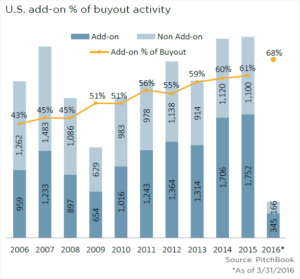 What has caused this trend? A number of reasons are generally cited, including:
 Investors have choices in how to allocate their investment dollars across the risk and return spectrum. Whether it be bonds, public company equity, or private company equity, an astute investor will evaluate the risk of return and expect to be compensated according to this risk.
 This article takes a look at the various situations in which trusts and estates (those that hold private business interests) need business valuation or M&A brokerage services.
 Research indicates that most business owners have 60-80% of their wealth tied up in their businesses. Yet in our experience few owners have a clear idea about the value of their business and few have done much thinking or strategizing about how to