
Will appear on Seller pages – RECENT SELLER ARTICLES

M&A Advisor Tip: Organize Your Financials

Buyers that pay top dollar usually expect to see clear, well-organized financial statements prepared according to generally accepted accounting principles (GAAP) and reviewed by a reputable CPA firm. If your business has more than $10 million in revenue, you should probably start investing in annual financial statement reviews at least three years prior to selling. Or, have a transaction-oriented CPA firm complete a “quality of earnings” report prior to going to market.

For a referral to a good CPA firm for your company or to receive further information, contact Al Statz, 707-781-8580 or alstatz@exitstrategiesgroup.com.

Valuing a Business in Bankruptcy

According to data collected by the U.S. Bankruptcy Courts, business bankruptcies declined from 60,750 (or 4% of total filings) in 2009, just after the 2008 financial meltdown to approximately 22,750 in 2019 (or approximately 3%).[1]  With overwhelming challenges ahead as a result of the Coronavirus Pandemic, the question is not if these filings will go up over the next 12 months but by how much.

Before I dig into valuing a business in bankruptcy, let’s review the relevant “chapters” of the U.S. Bankruptcy Code. These “filings” are as follows;

  • Chapter 7 – a liquidation proceeding where assets are sold by a trustee to repay unsecured creditors and, in the case of a business filing, the Company ceases operation[2];
  • Chapter 11 – a reorganization where a Company (as well as individuals) negotiate a plan with its creditors to pay a portion of the amount outstanding while remaining in business.[3]

What is Value in a Bankruptcy?

The U.S. Bankruptcy Code defines “insolvent” as

“…financial condition such that the sum of such entity’s debts is greater than all of such entity’s property, at a fair valuation…”[4].

It is at this time, when a business is insolvent, that an appraiser comes in to determine the value of the Company’s assets. However, there is no definition of value in the U.S. Bankruptcy Code, only the guidance that;

“Such value shall be determined in light of the purpose of the valuation and of the proposed disposition or use of such property, and in conjunction with any hearing on such disposition or use or on a plan affecting such creditor’s interest.”[5]

The value of the Company depends on the type of filing and the recovery plan if the company is to survive as a going concern. In a Chapter 7 filing, the asset value is based on a liquidation approach (orderly or forced) based on the expected timing set forth by a bankruptcy trustee. In a Chapter 11 filing, the value is based on a going concern approach, also dependent on the proposed timing, but tied to a financial and operational plan for reorganization that impacts the capital structure of the business.

Valuing a Business in Chapter 11 as a Going Concern

Under a Chapter 11 reorganization, the approval of a reorganization plan depends on whether the parties can negotiate a favorable outcome for the Company (or debtor) and the unsecured creditors. When this path to resolution fails, the U.S. Bankruptcy Court needs to rule on this insolvency and whether the reorganization plan proposed suggests that the value of the business is less than its liabilities. While this plan may include the sale of assets, subsidiaries or other court-mandated transactions, it always assumes that the Company will continue as a going concern that requires a valuation.

For example, in a recent court case, a valuation expert for the debtor concluded that the value of the business burdened with $317 million of debt was between $180 million and $220 million (midpoint of $200 million) while the expert for the unsecured creditors’ expert pegged the value between $335 million to $445 million (midpoint of $390 million). In effect, the unsecured creditors concluded that the business was solvent and that they are responsible for 100% of the liabilities of the business. The Court determined that both experts were highly qualified and used the same valuation methods and weightings. The differences came down to their selection of comparable companies. The final decision agreed with the debtor’s expert and the plan was approved and the terms “crammed down” to the unsecured creditors who had to take a haircut on the amount owed to them.[6]

Other key components or potential issues faced by an expert in valuing a business in bankruptcy include;

  • Forecast – The appraiser needs to determine the strength of the forecast in a proposed reorganization plan and whether a management-prepared projection shows bias towards a low case scenario.
  • Diligence – In court cases, either side will hire appraisers to determine the value of the Company as a result of the reorganization plan. This adversarial situation reinforces the importance of the appraisers’ diligence and strong support for key assumptions and inputs.
  • Comparables – As noted above, the question of comparability is key in the defense of the value determined using a market approach. Comparing a small niche software company to Google lacks, among other things, strength based on size, business model and portfolio of revenue streams. There is also a question as to how actively traded companies compare to a bankrupt company with inactive or no recent trading history.
  • New Debt – Determination of the interest rates available to the debtor and changes in the capital structure are key in determining the Company’s risk profile before and after the reorganization plan. Also important is the assumption of potential balloon payments and the need for asset sales or refinancing when these payments are due.
  • Hindsight – The court will accept a “known or knowable rule” but discourages the use of hindsight which may lead to bias.
  • Taxes – A consideration of the debtor’s tax situation including the possible utilization of NOLs and a change in ownership after the reorganization.

A Small Business in Bankruptcy

The above example underscores a frequent adage of appraisers that a big company is much easier to value than a smaller one. Whether it’s the lack of detailed financial information or the presence of operating agreements that may trigger a specific approach to and allocation of enterprise value, small businesses are almost always an extension of the individual owner operator and therefore always unique. In particular, professional service businesses in bankruptcy (such as an electrical contractor or a barber shop) may lack the ability to realize value, especially in Chapter 7 filings, for intangible assets that will remain with the business owner. Additionally, a market approach requires the use of different datasets that compare control transactions as opposed to publicly traded companies. Otherwise, the same issues above apply but with limited financial and management resources, a full detailed plan and forecast may not be part of an appraiser’s available information.

Unfortunately, the current health and economic crisis will likely cause an uptick in business bankruptcies and situations where appraisers need to determine value in unique and distressed situations.

Exit Strategies values control and minority ownership interests of private businesses for tax, financial reporting, ownership transfer, strategic and bankruptcy purposes. If you’d like help in this regard or have any related questions, contact Al at alstatz@exitstrategiesgroup.com.


[1] https://www.uscourts.gov/report-name/bankruptcy-filings

[2] https://www.usbankruptcycode.org/chapter-7-liquidation/

[3] https://www.usbankruptcycode.org/chapter-11-reorganization/

[4] https://www.usbankruptcycode.org/chapter-1/section-101-definitions/

[5] https://www.usbankruptcycode.org/chapter-5-creditors-the-debtor-and-the-estate/subchapter-i-creditors-and-claims/section-506-determination-of-secured-status/

[6] https://www.bvresources.com/articles/bvwire/bankruptcy-court-highlights-comparables-selection-in-assessing-experts-valuations

Market Pulse: Selling Price vs Asking Price

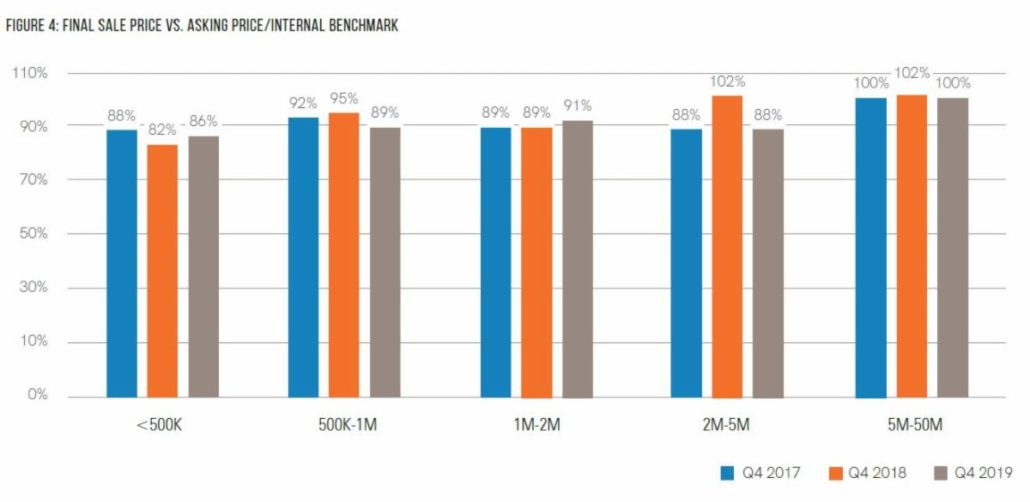
How much do businesses actually sell for as a percentage of asking price?  The following chart shows the results of this survey question from the latest Market Pulse Survey.

Presented by IBBA and M&A Source in Partnership with Pepperdine University

The groupings in the chart are selling price ranges for deals, in US dollars.  It should be noted that most $5-50 million enterprise value companies go to market without a price.

Each quarter, the M&A Source and IBBA (International Business Brokers Association), in partnership with Pepperdine University’s Private Capital Markets Project, publish the results of a survey of North American lower middle market M&A advisors and business brokers, called the Market Pulse Survey.

Feel free to contact Al Statz with any questions, at 707-781-8580.

M&A Advisor Tip: Know when it is time to sell.

When you no longer have the fight, get out of the ring.

Burnout is the second leading reason business owners sell, after retirement. Many business owners hold on too long, long after their drive has gone. When that happens, the business stops growing or even starts going backward – and the value of the business declines.

The best time to sell is when you’re energized and motivated by your work. If you see burnout on the horizon, find ways to reduce your burden or start preparing to sell your business.

For further information contact Al Statz, 707-781-8580 or alstatz@exitstrategiesgroup.com.
Selling Your Business to a Family Office

Business owners looking to sell their business, or attract an investment partner, may want to add family offices to their outreach strategy. These private family firms, established by high net worth families to manage their wealth, can offer unique advantages.

While family offices aren’t new, they have become more active in M&A in the last decade. In the past, family offices may have looked to private equity firms as a resource to grow their wealth, but new trends have many family offices investing directly in private businesses.

For a family office, direct investment can offer several benefits such as higher returns, greater control, and the ability to invest in industries that best fit their family expertise. By the same token, family offices can prove attractive to certain business owners and sellers. Here’s why:

Patient Capital

Private equity firms typically have five to seven years before they need to resell their investments and deliver a return to investors. But family offices aren’t limited to specific timelines and can hold their investments longer.

That buy and hold strategy can be a good fit for business owners looking to take some chips off the table without exiting entirely. A longer investment period gives them more time to grow the business with support from their new, prestigious partners. Sellers concerned about employee job security, community presence, and legacy issues may also prefer a longer time-frame.

Industry Specialists

These families made their fortune in business, and they tend to invest in the industries they know best. For business owners looking to retain a portion of their business, these buyers can provide untold value in terms of connections, influence, and expertise.

Less Controlling

Some family offices have a reputation for being somewhat hands off. They’ll provide resources to help your business grow, while generally taking a more flexible approach to oversight.

Often, family offices aren’t interested in replacing management. This can be good for owners who will retain equity and continue to lead. But it means that sellers looking for a fast exit may not be the right fit (unless you’re leaving a proven leadership team behind).

The takeaway is that family offices can offer a better fit for business owners looking at a variety of exit options. If you’re selling, talk to your advisor about adding these groups to your target buyer list.

Be aware that these groups can be hard to reach on your own. Many family offices operate under the radar. They don’t actively promote themselves or announce they’re searching for acquisitions. What they do is build relationships with advisors known to present quality investment opportunities.

To access these groups, work with an M&A firm with widespread industry connections, a large buyer database, and access to exclusive M&A research tools.

Contact Al Statz at 707-781-8580 or alstatz@exitstrategiesgroup.com for further information on what these family offices are looking for and how to best approach them.

The Four P’s of Selling a Business

Marketers sometimes talk about the four p’s (product, placement, price, promotion) of marketing. Known as the “marketing mix,” the emphasis a company puts in each area can have a direct impact on sales and profits.

And while selling a business is not like selling a product, we can use this idea to think about how certain factors impact a company’s value and sale readiness. The right mix will make your company more desirable to buyers and more likely to attract multiple competitive offers.

People

Human resources plays a critical role in your business’s saleability. As an owner, you need to be replaceable. Ideally, your business should continue to operate and grow even if you aren’t a part of day-to-day operations.

In the lower middle market, you’ll gain extra value by having a management team or key employee group that can run the business with little to no input from you the owner. Buyers want to know they can maintain your success even after you’re going.

When talking up your business to would-be buyers, talk up your people. Say “they did that” or “we did” whenever possible, instead of highlighting your own solo contributions.

It may seem counter intuitive, but the less your company needs you, the more it’s worth. Because if you truly are the only one with all the magic dust, your business is a risky proposition and will be harder to sell.

Performance

Generally, buyers want a business with a stable record of profits and preferably a growth trend. They will typically look at the last three years of financial performance, paying attention to the last 12 months.

A business is generally worth a multiple of its cash flow, specifically EBITDA adjusted for the owner’s salary and benefits. Drive cash to the bottom line, and avoid hiding unnecessary perks inside your financials, particularly in the last few years before a sale.

Look at cash-related issues like working capital, capital expenditures, fair market rent, and fair market payroll. If you’re underpaying yourself in terms of rent, your cash flow might not reflect the new owners cash flow. And if you’re working 80- hour weeks (longer than any paid manager could be expected to work), your current salary might not be an accurate reflection of the necessary replacement salary.

Cash flow is one of the most important numbers buyers will use when valuing your business. Make sure yours is accurate and tells a good story.

Potential

Buyers want a growth story and a vision for the future. They want you to sell them on the company’s growth potential.

You may be proud of what you’ve built, but it doesn’t do any good to tell would-be buyers that the business is doing “the best it possibly can.” That means there’s no where to go but down. Spend some time thinking about growth opportunities and what you might do if you had more energy, more capital, or were willing to take on new risk.

If you don’t have a vision for growth, talk to an advisor. Different buyers bring different assets and advantages to the table.

Price, aka Value

Not every company can go to market without an asking price. But for the ones that can, a no-price strategy gives the seller an advantage.

Ask two professional valuation experts to determine your business value, and you’ll probably get similar numbers. But ask two or more buyers to value your business, and their target price may vary significantly. That’s because your business is worth more or less to different buyers, depending on their motivations, resources, and business synergies. How they value your business will depend, in part, on how badly they want to reach their goal.

For further information on this subject or to discuss a current M&A or business valuation need, contact Al Statz, 707-781-8580 or alstatz@exitstrategiesgroup.com.

M&A Advisor Tip: Drive Cash to the Bottom Line

We all like to save money on our taxes. But hiding personal expenses in your tax return can do more harm than good. Most businesses are purchased as a multiple of cash flow (roughly EBITDA less capital expenditure needs, less increases in working capital as the company grows). If buyers and lenders can’t find your personal expenses in the financials or if the adjustments are so severe they border on tax evasion, they’ll be suspicious and possibly scared off.

It’s in your best interest to drive cash to the bottom line in the last 2-3 years before a sale.

Take a hit on taxes for a few years to get a much larger return when the company sells.

For further information on this topic or to discuss a potential business sale, contact Al Statz, 707-781-8580 or alstatz@exitstrategiesgroup.com.

M&A Advisor Tip: When the Kids Don’t Want the Business

Many business owners are surprised to find out their kids don’t want to take over.

Maybe the kids never wanted it. Or maybe they changed their mind after working in the business for a while. Either way, some business owners get caught having to make quick decisions about transferring their company to a third party.

Our advice: Talk to an M&A advisor, EVEN IF you plan to sell to your kids.

It can take years of planning to position a business for a successful sale, internal family transfer, or management buyout. Working with an advisor gives you options and a backup plan. We can help you create a transition plan that fits your goals … and your kids’ goals.

For further information on this topic or to discuss your exit options confidentially, contact Al Statz at 707-781-8580 or alstatz@exitstrategiesgroup.com.

M&A Advisor Tip: What Does It Feel Like When You Sell?

“Immense satisfaction tinged with loss.” That’s how one business owner described selling his business.

After putting years of hard work into building a business, many owners have a hard time letting go. Emotions run high, and those emotions can lead to some regrettable decisions.

As advisors, part of our role is to help you make sound choices when it comes to selling your business. We can help you sort through your emotions and your goals to find the right buyer to carry on your legacy, at the right time.

Smart preparation and planning make it easier to find the right fit. It doesn’t matter if you’re not ready to let go yet. Let’s start the conversation today.

For more information contact Al Statz, 707-781-8580 or alstatz@exitstrategiesgroup.com.

Building Value Means Building Leaders

It’s the New Year, that time when many business owners make a fresh resolve to develop their business. For some, that means updating equipment and driving sales. But others will focus on something more personal and possibly more pivotal: developing their leaders.

GF Data shows that a solid management team will increase the valuation multiple. For smaller businesses, the quality of your management team can be an even bigger factor, influencing whether your business sells at all.

Here are five ways to develop your managers and bring out their best:

1.  Coach, Don’t Rescue

A lot of leaders are “rescuers.” We care about our people and we want to see them succeed. But instead of onboarding correctly or coaching, we take over for them every time they have a problem.

Try coaching your team member to a solution. Help them find the courage to voice their own suggestions.

Questions like, “What do you think you should do?” often yield “I don’t know” answers. But a simple reframing can take the pressure off and encourage people to share their own thinking. If you’re trying to get someone past “I don’t know,” try one of these approaches:

“Suppose you did know. What’s a possible answer?”
“What if you knew you couldn’t fail?”
“Who’s the smartest person you know? What do you think they would do?”
Getting people to reframe the answer from someone else’s perspective can take away some of the discomfort we all feel about being wrong. What’s more, it helps them stretch and develop their own capabilities and confidence.

2.  Set a No-Penalty Zone

Create an environment where it’s okay for people to make mistakes. Begin by setting boundaries (wide boundaries, preferably) around decisions and actions they can take on their own. As long as people are acting ethically and in adherence to your corporate values, support the choices they make.

You can always coach people and explain why you would have made a different decision, but don’t impose any negative consequences. It’s better to have a proactive team than people who sit in a state of paralysis waiting for you to sign off on a course of action.

3.  Assess Your Team

Behavioral assessments can go a long way toward employee retention and development. From MBTI to DiSC, Strengths Finder, and others, tools like these can help your team identify their unique gifts and areas for improvement.

Invest in a business psychologist or other professional facilitator to take your team through the assessment. With the right guidance, the results can help improve team dynamics and equip you to be a better coach to each individual on your team.

4.  Give them a Voice

Give people a place at the table. For a long time, I made the vast majority of my business decisions based on what I thought was best for the company. But over the last few years, I’ve gotten better at listening to my internal team.

My management team has helped me challenge my assumptions, develop new initiatives, and most critically for me, stay the course on a promising business plan instead of following my next big idea.

5.  Get Out

We’re working with a husband and wife team who haven’t taken a vacation in five years. That’s not great on many levels. I don’t know if they haven’t developed their people or if the issue is more about an emotional, personal need for control.

If that sounds familiar, start slow. Take a long weekend away. Leave early on Fridays. Build up your ability to step away. As you leave your team in charge, their confidence will grow, and so will yours.

In terms of value, the ideal goal is to work yourself out of the business. Get yourself to a place where you can take extended vacations. Transition your role from working IN the business to working ON the business.

Buyers want businesses with transferable value. That means you need a leadership team that can sustain operations and, better yet, drive growth, without your direct involvement. If the business can’t survive without you, its value declines.

At the end of the day, building out your management team is a critical investment in your business. If it makes your life easier in the process (and it will), that’s just a nice side bonus.

For further information on what buyers look for in a management team, contact Al Statz at 707-781-8580 or alstatz@exitstrategiesgroup.com.