Will appear on Seller pages – RECENT SELLER ARTICLES

Why Business Owners Should Prepare to Sell Now


Al StatzReason 1:  Concentration of Wealth

A typical business owner has 70-80% of their wealth tied up in their business. That’s a lot of eggs to carry in one basket. On top of that, private businesses are less liquid and more risky than stocks, bonds and real estate investments.

Fortunately owners can control the value and sell-ability of their businesses. Now, whether they exercise that control is another matter!

Reason 2: Many Sales Are Unplanned

Over the years, studies have indicated that as many as 50% of all business sales are involuntary.  The cause may be personal in nature (death, disability, divorce, etc.), or related to a change in business or market conditions. If that 50% statistic is close to accurate, owners should make their businesses ready to sell and attractive to investors at all times. Definitely as they approach retirement age.

So, how sale-ready are most businesses?

In the Q1 2019 Market Pulse Survey of U.S. business brokers and M&A advisors by the Pepperdine Capital Markets Project of Pepperdine University, the consensus was that 70% of businesses are unsellable. These same professional intermediaries also estimated that 48% of businesses on the market won’t sell.  Now that’s a sobering statistic.

The quarterly Market Pulse Survey looks at businesses in the range of $500,000 to $50 million in enterprise value. Generally, larger businesses are more sell-able. This size effect has always been there, but in my experience it has become even more pronounced since the 2009-2010 recession.

Are business owners planning ahead?

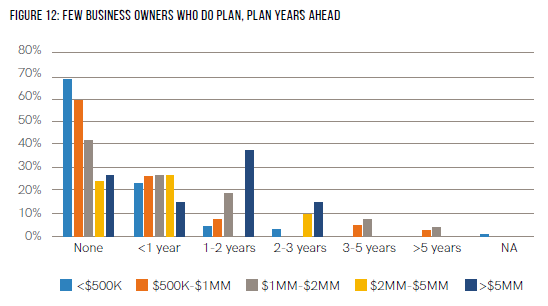
The intermediaries surveyed by Pepperdine in Q2 2019 indicated that most business owners conducted no formal planning prior to engaging a broker/advisor. Lower middle market business owners ($5-50 million enterprise value) were more proactive, though still roughly 40% failed to plan more than a year in advance.

Why owners may be resisting exit preparation.

From my perspective, some of the more common reasons business owners put off exit preparation are their independent personalities, blindspots caused by a lack of experience and objectivity, fear of looking foolish, skepticism (too many impostors and bad actors out there), the formality of the processes that have been proposed to them, and just being too busy working in their businesses.

The best way to maximize enterprise value and increase the likelihood of a successful ownership transition is to start preparing early. Don’t leave it to chance. For more information see my recent blog titled, Failing to Plan Your Exit is Planning to Fail. Or visit this page of our website for an overview of the exit planning process.

*          *          *

Al Statz is founder and president of Exit Strategies Group, a leading M&A advisory and business valuation firm with offices in California and Portland Oregon. Al can be reached at 707-781-8580 or alstatz@exitstrategiesgroup.com. Feel free to request a copy of the latest Market Pulse Survey.

Nine Warning Signs Your Buyer Can’t Close the Deal

The proof is in the pudding. It ain’t over ’til it’s over. Don’t count your chickens before they’ve hatched. Pick your cliché. Just because someone makes an offer to buy your business doesn’t mean they will close the deal.

As a seller, you need to look at more than dollar signs on a purchase offer. Make sure your advisors are researching and asking questions to figure out which buyers are for real, and which ones are just talking a big game.

Sometimes buyers want to rope you in to an exclusive negotiation. They throw out a high price, fully intending to negotiate down as they conduct due diligence and “discover” weaknesses in your business.

Some buyers have big egos and want to be the big dog at the table. But their balance sheets or lending relationships can’t really support the promises they’ve made.

Still others make what they believe to be legitimate offers with good intent. But if they’re not the final decision maker — the person controlling the checkbook— their efforts might be scuttled by a higher up, or a lender, who simply doesn’t see the same advantages in the deal.

These things happen more often than you probably think.

Nine warning signs your buyer won’t follow through:

  1. Too good to be true. They offer a super high price and a 45-day closing “guarantee no risk” if you’ll sign their exclusivity agreement. Your buyer may have ulterior motives. They’ll get access to your sensitive information and get you off the market (weakening your position). Later, they’ll try to renegotiate a sizeable haircut or walk away when you don’t accept their lowball offer. Either way, they gained meaningful competitive intelligence which could significantly hurt your business or its value going forward.
  2. Too vague. They won’t estimate cash at closing. They say, “We’re going to try to get as much as we can.” Or, “We’re not quite sure yet.” A good buyer should have an idea of how much of the purchase price will be paid in cash at the closing.
  3. Unclear funding plan. They won’t disclose their lending sources. A buyer isn’t qualified if they can’t demonstrate financial ability to fund the deal.
  4. Lack of transparency. They won’t connect you to their prior business partners. If they’ve done acquisitions in the past, they should provide seller references. We want to know what the buyer is like to work with and if they do what they say they’re going to do.
  5. “Hidden” history. They won’t disclose anything about their acquisition history. A buyer who keeps their past business under wraps may not have as much experience as they say they do.
  6. No digital footprint. We’re looking for a website, press releases and announcements of past companies the buyer has acquired. Ideally, we’d like to see a few published news items, too. Active acquisition firms want to get their name out there.
  7. Fuzzy deal terms. Once you get to the letter of intent (LOI) stage, you need to strike a fine balance between strict detail and vague conditions. While this is generally not the time to demand all the deal specifics, unclear deal terms could put you in a position of weakness later on. Alternately, a vague LOI could be a sign your buyer is kicking tires and not really committed to a deal.
  8. Slow to respond. Perhaps your buyer was engaged and enthusiastic at the start of the process, but now they’re taking a long time to get back to you. If there’s a noticeable change in communication, that’s a signal you’re no longer a priority acquisition target.
  9. No control over the purse strings. Buyers reps and corporate development teams aren’t the final decision makers. Business owners without enough capital to fund their own deals aren’t the final decision makers. These buyers have to sell your deal to their lenders or other equity partners, and that introduces risk into the transaction.

As you evaluate offers for your company, you have to consider whether one buyer is more likely than another to get a deal over the finish line. Some buyers are just bad actors, looking to take advantage. In other cases it’s a lack of time, money, information, experience or authority that can derail a deal.

M&A advisors are skilled at recognizing these warning signs and helping you avoid these types of problems. Contact Al Statz at 707-781-8580 or alstatz@exitstrategiesgroup.com for further information or to discuss a potential sale, merger or business acquisition need. Exit Strategies Group is a partner of Cornerstone International Alliance.

Failing to Plan Your Exit is Planning to Fail

Al StatzBen Franklin is credited with saying, “If you fail to plan, you are planning to fail.” And Warren Buffet once said, “Someone’s sitting in the shade today because someone planted a tree a long time ago.” These sayings are great reminders for business owners looking to exit.

For most business owners, their company represents the lion’s share of their net worth. It also represents their life’s work and a legacy worth protecting. Getting their exit right takes some planning.

However, coordinating all of the business, management, financial, legal, tax, estate, family, legacy, market and personal considerations is complicated and emotional for owners. And few have the time (or the training) to tackle all of this on their own, while running their business. Therefore many owners procrastinate when it comes to exit planning.

Failing to Plan

Failing to prepare for an exit can result in a business owner …

  • being forced by unplanned circumstances to exit involuntarily in a bargain sale, sale to a competitor or liquidation
  • wasting time and money on one or more sale transactions that fail to close
  • undervaluing their business
  • giving up more of the proceeds in taxes than necessary
  • prolonging retirement and failing to achieve their retirement goals
  • failing to leave a lasting legacy
  • burdening their family with matters that they were unprepared for

Whether you intend to transfer your company to family, partners, managers, a third party, private equity or a strategic buyer, exit planning is well worth it.

Eight Benefits of Exit Planning

  1. Identifies value and transferability gaps – a key starting point
  2. Makes your company more attractive to buyers
  3. Increases value for all shareholders
  4. Produces a smoother management transition
  5. Minimizes risks
  6. Minimizes taxes
  7. Establishes clear priorities, strategies and time frame
  8. Prevents costly mistakes

On a personal level, exit planning settles your mind and re-energizes you by focusing your efforts and giving your work greater purpose.

Fortunately, you don’t have to learn the ins and outs of exit planning. This is where firms like Exit Strategies come in.


Contact Al Statz at 707-781-8580 or email alstatz@existrategiesgroup.com for more information on simple and straightforward business preparation. We can help you create a plan, and coordinate with and introduce you to the other professionals you’ll need. As always, everything we discuss will remain confidential.

Opportunity Zones: a Compelling Tax-Advantaged Investment for Business Sellers

Cashing in on the sale of your business is the final reward for many years of dedication and hard work. Then your CPA tells you how much you will owe in taxes. It’s a shock, but there’s a relatively new reinvestment opportunity that may help trim your tax bill …

In April 2018, The U.S. Department of the Treasury and the Internal Revenue Service (IRS) designated Opportunity Zones in 18 States. The Tax Cuts and Jobs Act created Opportunity Zones to spur investment in distressed communities throughout the country. New investments in Opportunity Zones can receive preferential tax treatment.

Under the Tax Cuts and Jobs Act, States, D.C., and U.S. possessions nominate low-income communities to be designated as Qualified Opportunity Zones, which are eligible for the tax benefit. Attracting needed private investment into these low-income communities will lead to their economic revitalization, and ensure economic growth is experienced throughout the nation,” said Secretary Steven T. Mnuchin. “The Administration will continue working with States and the private sector to encourage investment and development in Opportunity Zones and other economically disadvantaged areas and boost economic growth and job creation.”

Qualified Opportunity Zones retain this designation for 10 years. Investors can defer tax on any prior gains until no later than December 31, 2026, so long as the gain is reinvested in a Qualified Opportunity Fund, an investment vehicle organized to make investments in Qualified Opportunity Zones. In addition, if the investor holds the investment in the Opportunity Fund for at least ten years, the investor would be eligible for an increase in its basis equal to the fair market value of the investment on the date that it is sold.

How Opportunity Zone Funds work

An investor who has triggered a capital gain by selling a business or real estate, can receive special tax benefits if they roll that gain into an Opportunity Fund within 180-days. Advantages are:

  • The payment of capital gains is deferred until December 31, 2026
  • It reduces the tax owed by up to 15% after 7-years
  • There is zero tax on gains earned from the Opportunity Zone Fund

If you’re planning to realize a sizeable capital gain or recently sold an asset where there is a capital gain (within the 180-day filing window), Opportunity Funds may help to keep more in your bank account and less in the federal treasury. It’s worth a look. Consult with your CPA or financial advisor.

Bob Altieri is a senior M&A advisor and business valuation expert with Exit Strategies Group. He can be reached at boba@exitstrategiesgroup.com.

California’s AB5 Law May Impact Small Business Values

Adam Wiskind, CBIAssembly Bill 5 (AB5), signed into law last month by governor Gavin Newsom, will impact the valuation of many small businesses in California that have grown to depend on independent contractors.  For impacted owners intending to sell in the near term, this new law may require a change of plan.


The new law, which goes into effect on January 1, 2020, creates an explicit three-part test for whether a worker can be classified as an independent contractor.  A worker can only be considered an independent contractor if:

  • (A) the worker is free from the control and direction of the hiring entity in connection with the performance of the work, both under the contract for the performance of the work and in fact; and
  • (B) the worker performs work that is outside the usual course of the hiring entity’s business; and
  • (C) the worker is customarily engaged in an independently established trade, occupation, or business of the same nature as the work performed.

AB5 exempts many occupations including doctors, dentists, lawyers, engineers, architects, accountants, real estate agents, travel agents, graphic designers, human resources administrators, grant writers, marketers, fine artists, investment advisors, broker-dealers and salespeople provided their pay is based on actual sales, rather than wholesale purchases or referrals. However, many small businesses in California that regularly employ independent contractors for work that is within the usual course of their business are not exempt.  For these businesses reclassifying workers could add as much as 30% to labor costs.  Labor intensive service businesses will be most impacted. Court reporting, janitorial and delivery services are typical examples.

Valuation Impact

Non-exempt California businesses that have to reclassify independent contractors to employees will likely see a contraction in enterprise value as buyers (and banks and appraisers) apply the expected increase in labor cost to proforma financials and guess at how much of the increased cost can be passed along to consumers. As businesses in a particular non-exempt industry convert from independent contractors to employees, the competitive playing field will be re-balanced.  Some who choose not to comply will go out of business. Those who already comply could see an increase in business, and value.

Owner Options

Business owners are considering their options to respond to the new law and its impact on valuation, including:

  1. Mount legal or policy challenges – The major gig-economy platform companies will challenge the law and small businesses may follow suit.
  2. Relocate work outside California – Can work currently being done by local independent contractors be transferred to contractors outside of California?
  3. Ignore the law – Some owners will no doubt continue with business as usual in the hopes that they don’t face a legal challenge.
  4. Reclassify workers and absorb the additional costs – The new law will raise costs for those who reclassify workers, and likely for the consumers of their products and services. There is a lot to consider here.  Which workers should be reclassified?  How will worker roles change? What are the cost implications?  How will these changes impact supervision, accounting, compliance and insurance requirements? Will the change result in a more committed and productive work force?

Regardless of how they respond, business owners who have spent years building their businesses under an independent contractor model and are impacted by AB5 are at crossroad. Hopefully this article raises awareness of the issues and helps some owners evaluate their options. If you are one of these owners, be sure to get professional legal and HR counsel.

Adam Wiskind is an M&A advisor at Exit Strategies Group and is a Certified Business Intermediary based in Sonoma County California.  If you are interested in better understanding this topic or in selling a $1-50 million revenue California business, contact Adam at awiskind@exitstrategiesgroup.com.

Why business transactions don’t close: Signs of a flaky Buyer/Seller

Selling or buying a business is time consuming, emotional and stressful, and having a deal fall through can be demoralizing. But the reality is that only a fraction of potential business acquisitions actually close. Many deals never really get off the ground. Even deals that make it to the letter of intent (LOI) phase often don’t close. When it comes to selling or buying, you really need to find out if the other party is serious and likely to perform. But, how do you know? It’s not as if it’s written on their foreheads.

Fortunately, there are tell-tale signs that you may be dealing with a person who is impractical, flighty, unreliable, inconsistent, indecisive, deceitful or will flake out before closing day. If you’re worried that you might be dealing with a flaky buyer or seller, look for these signs.

1. The buyer or seller is untrustworthy.

Before buying or selling, learn to do research on the buyer or the seller. It is still your asset before they buy it, and it will be your asset when you buy it from them, so it is best that you do some checking on the character of the individual, company or private equity group you are dealing with. Look up past deals they have done and check references.

2. The buyer seems to have financial problems.

When a buyer is financially weak, there’s a strong chance that buyer won’t make it to closing. Buyers should show proof of funds for a down payment in order to make an offer on a potential purchase, and in some cases get prequalified for a loan. Try to avoid entering into an exclusive LOI without proof of funds. If a buyer won’t agree to provide proof of funds early on, or stalls for any reason, simply walk away.

3. The buyer or seller is slow to act.

When a seller or buyer drags his feet in providing disclosures or other diligence it could mean lack of interest or something to hide. If they are serious about buying or selling, rest assured they’ll be quick to act and respond with clear and accurate information or a thoughtful reply. If you’re hearing a lot of “I don’t know,” “maybe,” or “I’ll let you know,” they are not ready for a transaction. Or if you message them “can you meet me at XYZ at 5:30 pm?” And they reply with “I gotta see”, or “I work today”, and they don’t reply with a follow up time and place they can meet you, chalk this one up to the birds. They’re not serious about doing the deal.

4. Lack of transparency.

If a buyer or seller seems to be less forthcoming, it doesn’t mean the deal will fall through, but it isn’t a good sign. If there’s anything less than full transparency, there’s generally a reason. A lack of transparency has a lot of gray areas, it could mean that they can’t really provide all the information that you have asked for and are just trying to buy time till they can get it. Nonetheless, a lack of transparency is a sure sign of a flake buyer or seller.

5. The seller, buyer or agent becomes less responsive.

One of the biggest signs a sale is going to fall through is if there’s a noticeable change in the communication from a once cooperative party. We all live busy lives and are can’t always check our texts and phones every hour, BUT, when it comes to doing business deals, time is often a deal killer. So, when a buyer or seller takes days to reply to simple requests, you are probably wasting your time. Still, don’t assume that the seller or buyer is no longer interested. A text or email message can be missed or misinterpreted, and calling or meeting with the other party is imperative. Nonetheless, avoid anyone that is taking longer than necessary to reply.

6. Low enthusiasm for the deal.

Enthusiasm is a sign that they want the transaction to close. If you sense that the other party is just going through the motions and isn’t all that excited to be selling his or her business or jazzed about buying, it’s a warning sign. There’s a fair chance that your deal will fall apart. Perhaps the prospective buyer has found a different business that they are excited about. Whatever the reason, you’ll definitely want to address it right away

Another sign that a purchase is going to fall apart is when one partner on the buy side loves the business, but their partner is more hesitant. When it’s a joint venture, all partners should be equally excited to sell or buy, it shouldn’t be one-sided.

In Summary

Flakes often flash clear warning signs through their lack of transparency, indecision, inaction and lack of preparation. But it is easy to miss or look past these warning signs if you haven’t been through this process numerous times. The surest way to avoid flaky buyers or sellers and increase your chances of a successful deal is to hire a business broker, M&A advisor, investment banker or transaction intermediary. These professionals spend a lot of time watching for these signs, and make appropriate recommendations and take appropriate actions when they occur.

*          *           *

For more information on the use of earnings and cash flow measures used in business valuation, or to discuss a current business valuation need, contact Joe Orlando at jorlando@exitstrategiesgroup.com.

Exit Strategies Advises Olympus Controls on Sale to Applied

PORTLAND, OR (August 22, 2019) — Exit Strategies Group, Inc. is pleased to announce that Olympus Controls Corp. has been acquired by Applied Industrial Technologies.  We represented Olympus and its shareholders as their exclusive M&A advisor.

Established in 1998, Olympus Controls is a leading distributor of world-class machine automation products focused on assemblies and engineered solutions. Olympus specializes in motion control, robotics, machine vision, sensor and IIOT technologies, and is one of the largest and fastest-growing automation technology centers in the U.S., with 80 skilled employees serving 12 Western states from 5 office locations.

Clients look to Olympus Controls for advanced technologies as well as sophisticated application support, electromechanical assembly, custom system design and integration, and software development. Olympus automates machines in many industries including life sciences, pharmaceutical and biotech, semiconductor, electronics and display, food and beverage, warehousing and third-party logistics, cloud services (data centers), packaging, machining/forming/3D printing, aerospace and others.

Applied Industrial Technologies (NYSE: AIT) is a leading value-added distributor of power transmission products, engineered fluid power components and systems, flow control solutions and other industrial products, with revenue exceeding $3 billion. The acquisition of Olympus serves to establish an automation technology platform.

Scott Hendrickson, Olympus founder and CEO, noted “The synergy and strategic fit between Applied Industrial Technologies and Olympus Controls was way too strong to overlook. We can instantly leverage our shared client relationships and unique Engineered Solutions business models to make an immediate and impactful dent in the machine automation market. Our team has always had a high degree of respect for Applied’s dominance in the fluid power space and Olympus Controls brings an exciting opportunity for them to strengthen and expand their technology offering in motion control, machine vision, robotics and industrial networking.”

“Engaging Exit Strategies to help us navigate the sale process was a great decision. Al Statz and his team brought a wealth of M&A experience, and provided outstanding advice, service and value from start to finish.” Mr. Hendrickson added.

Exit Strategies is honored to have helped Olympus shareholders and management achieve this outcome. We congratulate both companies and look forward to seeing them innovate and grow in the years ahead.

We see interest in industrial automation and robotics acquisitions, recapitalizations and mergers remaining strong for some time as the industry grows and consolidates. Trends driving growth in automation include the need to improve productivity and quality in the face of scarce skilled labor and rising labor costs, increased use of electronics and internet connectivity in all types of products, continued miniaturization of electronics, rapidly-changing consumer tastes, new warehouse and data center applications, and recent advances in enabling technologies such as vision, 3D sensing and AI. Rising occupancy costs and regulatory requirements are also contributing factors. U.S. Companies have to invest more in automation in order to compete on the global stage, or they risk extinction.

*          *          *

Exit Strategies is a California-based M&A advisor and business valuation firm serving lower middle market U.S. companies in several industries including automation and robotics distribution, system integration and manufacturing.  For further information about Exit Strategies’ services, contact Al Statz at 707-781-8580.  Terms of the Olympus-AIT deal will not be disclosed.

Profit from Intangible Assets in a Business Sale

The sale of a business includes intangible assets. This article explains what intangible assets are and how articulating, supporting and protecting them enhances business sale outcomes. Let’s get started.



What is an Intangible Asset?

Intangible assets are things that are non-physical in nature that you can identify, describe, document (e.g. a contract, list, logo, drawing or schematic) and, most importantly, transfer. Intellectual property is an example of an intangible asset.

The Financial Accounting Standards Board (FASB), in its ASC 805 standard for reporting of Business Combinations, separates intangible assets into these categories:

  1. Marketing-related: such as trade names, trademarks, non-compete agreements and URLs
  2. Customer-related: customer lists, contracts and relationships, order backlog
  3. Artistic-related: works of art, magazines, books and articles
  4. Contract-based: permits and licenses, licensing and royalty agreements, franchise agreements
  5. Technology-based: trade secrets, databases, patented technology

Do all intangible assets have value?

Just because an intangible asset exists, doesn’t automatically give it economic value. To have value it has to produce some form of economic benefit. For example:

  • Generate operating or licensing income
  • Reduce operating expenses or future capital spending
  • Reduce business risk

Of course, an intangible asset must be transferable in a sale to have value to a new owner. (Intangible asset valuation is a topic for another day.)

Goodwill is excluded from the above list because it is considered to be a blended residual asset. Goodwill is influenced by factors such as high profit margins, barriers to market entry, competitive advantages, a regulated protected position or lack of regulation, longevity in the market, a trained work force, etc.  Synergistic value associated with premiums paid by strategic buyers are often considered “blue sky” value above a “justifiable” goodwill value.

Document to Impress

After you take an inventory of your company’s intangible assets, the next step is to be sure that the key ones are documented in a manner that will satisfy buyers. For example, support for customer-based intangibles may include: a well-populated CRM database, master supply agreements, vendor quality audit records, open quote files, important correspondence, sales and contribution margin by customer history, AR aging schedules, purchase orders, etc.

Protect Your Assets

While documenting your company’s primary intangible assets, you are likely to uncover some that need better protecting through public registration (e.g. patents), securing or improving contracts, or better restricting access.

For many of our clients, trade secrets are their most valuable intangible assets. Suppose a significant portion of your company’s profitability is attributable to a proprietary production process. Ask yourself these questions: Is the process perfected and well documented? Are you taking appropriate measures to keep the process secret? Is access sufficiently limited? Do you have appropriate data security? Do you have non-disclosure agreements with third parties?  Do you have confidentiality agreements with your employees? If not, you know what to do.

Capitalizing on Intangible Assets in a Sale Process

Your intangible assets become the focal point of the Confidential Information Memorandum (CIM) prepared by your M&A advisor. The CIM can also articulate those intangibles that are underutilized and have potential to produce economic benefits to a new owner. We use our knowledge of your intangible assets to decide which target strategic acquirers are likely to derive the greatest benefit from them. We tailor our outreach strategy and communications accordingly. In the end, this generates more interest and better offers for the company in an M&A auction process. The M&A advisor can also advise on how and when to disclose sensitive details about key intangible assets during the discovery and due diligence phases of a merger or acquisition process.

*         *          *

An investment in perfecting, identifying, documenting and protecting intangible assets is usually well rewarded in a sale. Exit Strategies helps clients take full advantage of the intangible assets in their businesses when going to market. If you’d like help in this regard or have any questions, you can reach Al Statz at 707-781-8580 or alstatz@exitstrategiesgroup.com.

Phase I Environmental Assessment in M&A Transactions

A Phase I environmental site assessment is commonly required by buyers and lenders in merger and acquisition transactions that include commercial real estate. One may even be called for when the target company (seller) uses or stores hazardous materials at a leased facility.

Sellers are generally rewarded for conducting a Phase I assessment before taking a deal to the marketplace. Understanding environmental risk allows sellers to argue for a higher price and increases the likelihood of closing a deal. This article explains why.

What is a Phase I Environmental Assessment?

A Phase I environmental site assessment (ESA) consists of a thorough inspection of a commercial property and research into its current and historical use to identify potential environmental contamination liabilities. These assessments are conducted by independent, certified and trained professionals. The environmental expert produces a written Phase I report. When site contamination is found to be likely, a Phase II investigation follows, which involves taking soil, groundwater or material samples.

What All Buyers Want

When acquiring a business, buyers want to understand the potential liability for environmental contamination on facilities owned or operated by the target company; any past non-compliance with environmental laws and regulations; and costs to comply with any post-closing environmental compliance obligations. An understanding of their potential liabilities as a parent or successor dictates their acquisition strategy.  The scope of a buyer’s potential liability for existing environmental contamination issues can influence the basic structure of the transaction — asset or stock purchase — and proposed purchase agreement provisions.

How Sellers Benefit

Obtaining a Phase I report before putting a business with real property up for sale provides several benefits to sellers. It flags potential problems that the seller can mitigate or remediate in advance. If contamination is reported to be present or likely, the seller can better compare the value of bids and make better decisions regarding indemnities and potential insurance products. Having a Phase I report increases a buyer’s comfort, and results in better offers, less renegotiation and a smoother LOI-to-closing process.

Al Statz is founder and President of business valuation and M&A brokerage firm Exit Strategies Group, Inc., which has offices in California and Oregon. For further information on this subject or to discuss a valuation or M&A question or need, confidentially, you can reach Al at 707-781-8580 or alstatz@exitstrategiesgroup.com.

Roundup of Recent Sale Transactions

Sitting down and writing quality articles on business valuation, exit planning, mergers and acquisition strategy has taken a back seat this year, thanks to a strong M&A market. In this post I will recap many of the transactions for which Exit Strategies (ESGI) provided sell-side advisory services during the first half of 2019.

I haven’t included deals that we were asked not to announce. Nor have I included the internal buy-sell transactions, management buyouts and generational transfers for which ESGI provided an independent business valuation. As always, deal terms are not disclosed to respect the privacy of our clients.

Sale of Eldercare Services to Home Care Assistance

Eldercare Services is one of the San Francisco Bay Area’s top professional eldercare management and home care services providers. The baby boomer owners of ES were looking to turn their business investment into cash (i.e. “liquify” their investment), maximize value and retire. Home Care Assistance is a leading provider of home care for seniors in 150 regions throughout the United States, Canada, Puerto Rico and Australia. (service, health care)

Sale of DC Precision to Tecan Group

DC Precision, established in 1999, manufactures high precision plastic valve assemblies for life science OEMs and metal products for Silicon Valley high-tech manufacturers. Our client was ready to pursue other business interests. Tecan Group is a Swiss manufacturer of automated workflow equipment for pharmaceutical and biotechnology companies, university research departments and diagnostic laboratories. (contract manufacturing, CNC machining, proprietary technology, turn-key assembly)

Sale of Precision Asphere to II-VI Optical Systems

Precision Asphere produces aspherical optical components (lenses and mirrors) using proprietary surface-forming technology. The majority owner wanted to retire. II-VI Optical Systems develops and produces highly engineered materials and material systems for medical, defense, aerospace and military clients.  (manufacturing, technology)

Sale of Axis of New England and New York to Motion Industries

Read the ESGI announcement here.  Our clients were looking to take advantage of industry consolidation and maximize value through a competitive M&A sale process. (distribution, manufacturing, robotics, technology, service, system integration)

Sale of DZINE Living to Haworth

DZINE is an interior design services and contemporary European furnishings retailer in San Francisco. Our clients were looking to align with a major industry player that would help DZINE to expand its footprint. Haworth is a global company that designs and sells furniture, furniture systems, architectural products, textiles, wall surfaces, and ergonomic and technology tools for workspaces, education and health care. (retail, service)

Sale of You & Me Children’s Center to an Industry Investor

Founded in 1981, You & Me Children’s Center is a local preschool committed to providing a nurturing, safe and educational environment for children. The owner wanted to retire, liquefy her investment and see her legacy survive. The buyer is an experienced preschool operator. (service, education)

Sale of Home Tutoring Plus to a Private Investor

Home Tutoring Plus is a tutoring company serving schools and home school families throughout much of Northern California. Professional tutors provide individualized lessons, in-home and online. Our client engaged us to locate a buyer that would preserve her legacy while maximizing her investment so she could pursue new interests in retirement. (service, education)

Sale of Redwood Building Maintenance Company to Silicon Valley Building Services

Founded in 1965, Redwood Building Maintenance is a full service janitorial and building maintenance company serving the North San Francisco Bay Area. The family owners were ready to retire.  Silicon Valley Building Services primarily serves the south and east Bay Area and this gave them an opportunity to expand. (B2B services, contract maintenance)

Sale of Banner Enterprises to Valley Comfort

Banner Enterprises and Valley Comfort Heating and Air are both full service commercial HVAC companies serving the Bay Area. Our client was looking to sell his business and building in order to retire and reinvest. (construction, services, real estate)

Sale of Communique Interpreting to DCARA

Since 1994, Communique Interpreting has provided in-person sign language interpreting services from Monterey to the Oregon border, in medical, employment, education, legal, performing art and social services settings. Our client wanted to sell her business and building and retire. DCARA, a 501(c)3 charitable organization, provides interpreting, advocacy and employment services for hearing impaired children, adults and families in Northern California. (services, non-profit, commercial real estate)

Sale of a Dietary Supplements Producer to a Strategic Buyer

A producer of herbal supplements sold through U.S. medical practitioners. The owner engaged us to find a strategic partner that could scale the company and allow him to reduce his involvement in operations and transition to retirement. (health care, manufacturing)

Market Observations

Two themes jump out at me: most acquirers were strategic and most sellers were looking to retire. Indeed, we’re seeing tremendous strategic acquisition activity in most industries. Most sellers are well positioned to maximize value through a structured auction (competitive bid) process run by a professional M&A brokerage firm like ours. As long as baby boomers continue to age out, Exit Strategies will be here to facilitate their retirements.

Action Items

If you are considering exiting your company for any reason, call or Email us to discuss your goals and circumstances, and how you can leverage Exit Strategies’ process, resources and experience to improve your results. If you are waiting for market conditions to improve, stop waiting and start the process!


Al Statz is founder and President of business valuation and M&A brokerage firm Exit Strategies Group, Inc., which has offices in California and Oregon. For further information or to discuss a valuation or M&A question or need, confidentially, you can reach Al at 707-781-8580 or alstatz@exitstrategiesgroup.com.