
Will appear on Seller pages – RECENT SELLER ARTICLES

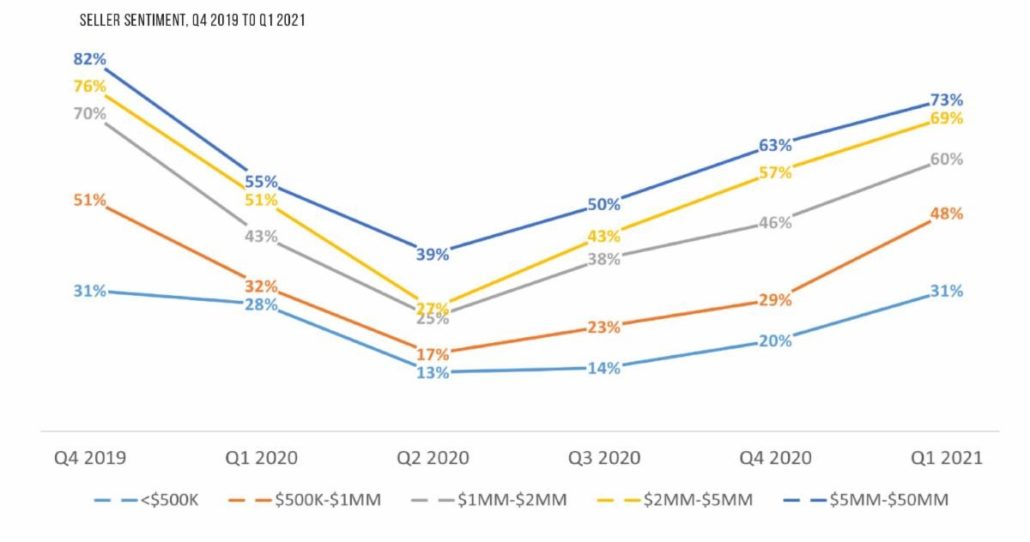
Seller’s Market Sentiment Back to Pre-Covid Levels

What a difference a year makes! Sellers of $1M+ enterprise value businesses have an advantage, with roughly 2/3 of M&A advisors and business brokers calling it a seller’s market for these larger businesses. Confidence is rising across all sectors.

Market Pulse Survey – Quarter 1, 2021 Presented by IBBA & M&A Source

Al Statz is the CEO of Exit Strategies Group. For more information on exit planning or to discuss a potential M&A or business valuation need, contact Al at alstatz@exitstrategiesgroup.com

Put Time into Planning Sale of Business

Over my 19 year M&A advisory career, I have met many business owners who spent more time planning their children’s wedding, their 50th wedding anniversary, or even their fantasy football draft, than they spent planning for the sale of their business.

According to the quarterly Market Pulse Report, we know that when it comes time to sell their business, less than half of all business owners plan ahead. That means that most owners wait for some type of trigger event before they go to market. Those triggers are unplanned and unpleasant in nature, stemming from a family health issue, conflict, or burnout.

According to Christopher Snider, CEO of the Exit Planning Institute, 50% of business owners exit because of one of the “Dismals Ds”: death, divorce, disability, distress, disagreement.

Unfortunately, that often means business performance is on the decline. Or, at the very least, it means the business owner hasn’t made specific changes that will better position their company for a sale or transition.

Selling a well-prepared business is a completely different experience than selling due to a Dismal D trigger event. You have more leverage, and the process is less stressful as you are proactively executing a strategy versus reacting to an event in your life. With planning, you’ll be able to walk away from the closing table feeling satisfied and confident that you made the right choices.

It’s true that you may still be able to sell your business without planning. But the more you plan, the more options you have when you want to exit. When a business owner is well-prepared with an attractive business, they typically receive more offers. That gives you more leverage in the sale negotiations.

The holy grail is when you have prepared the business, you are emotionally ready, and the M&A market is robust. If you can pull that off, it’s typically a win in terms of valuation and deal structure. Plus, the sale process will go faster and smoother, reducing the inevitable emotional turmoil for you.

Not everyone achieves such perfect timing, but your chances are significantly better if the sale is part of a planned exit strategy. Whether you’re 10 months or 10 years away from exiting your business, take time now to truly think about how and when you will leave.

Have a conversation with an M&A advisor. It doesn’t mean you have to sell right away. But you become better educated about your exit options, the importance of timing, and how the process works.

Al Statz is the CEO of Exit Strategies Group. For more information on exit planning or to discuss a potential M&A or business valuation need, contact Al at alstatz@exitstrategiesgroup.com

M&A Advisor Tip: Confidence in Numbers

Most of our clients have CPA Compiled or Reviewed financial statements, and some go a step further with Audited statements. Reviewed financial statements are acceptable, and you can do even better with Audited statements a year or two before you sell.

With validated financial accuracy, you increase buyer confidence, shorten due diligence, and help get your company sold. We’ve had buyers tell us they’ll bid a quarter to a half to a full turn more on price/earnings multiples for a business with Audited financial statements.

As your business grows, a quarter turn can make a big difference in the purchase price that far exceeds the additional cost of an Audit.

For advice on exit planning or selling a business, contact Al Statz, CEO of Exit Strategies Group, Inc., at alstatz@exitstrategiesgroup.com.
Exit Strategies Group is a partner in the Cornerstone International Alliance.

M&A Advisor Tip: Go ugly early

We have a common saying: “Go ugly early.” When you’re selling a business, put issues on the table right away. Whether you’ve just lost a customer, your backlog isn’t what it was, or you’re operating at capacity—be up front.

Providing clarity around your business flaws serves two purposes. First, it makes the whole process more efficient. If customer concentration is a no-go issue for a buyer, let’s flush them out early before we’ve invested any time or money. Transparency also brings credibility, establishing you and your advisors as honest, ethical people. That goodwill can go a long way in negotiations.

For further information on this topic or to discuss a current M&A need, Al can be reached at 707-781-8580 or alstatz@exitstrategiesgroup.com.


Exit Strategies Group is a partner of Cornerstone International Alliance.

Ten Commandments of Successful Business Exits

Business owners contemplating a sale may be asking the question: What are the most important principles to achieve a successful business exit? Listed below are ten practical directives to help you make better exit planning decisions and achieve a successful sale.

I. I shall plan ahead.

II. I shall not depend on miracles

III. I shall prepare my business

IV. I shall not wait for perfect timing

V. I shall help buyers buy

VI. I shall have buyers competing to buy

VII. I shall keep my eye on the ball and my lips sealed

VIII. I shall not go it alone

IX. I shall use experienced professionals

X. I shall not let time kill my deal

For expanded explanation of these ten practical directives to help you make better exit planning decisions and achieve a successful sale, click here to download the pdf:

Ten Commandments of a Successful Exit • Exit Strategies Group, Inc.

For more information on the business sale process or exit planning, email Louis Cionci at LCionci@exitstrategiesgroup.com or call him at 707-781-8582

Market Pulse Survey – Why business owners are selling

The following chart shows the reasons business owners decided to sell their businesses in 2020. As in the past, owner retirements led the way.

These are the results from the Market Pulse Survey conducted in the 4th quarter of 2020. Each quarter, the M&A Source and IBBA (International Business Brokers Association), in partnership with Pepperdine University’s Private Capital Markets Project, publish the results of a survey of North American lower middle market M&A advisors and business brokers, called the Market Pulse Survey.

Feel free to contact Al Statz with any questions, at 707-781-8580.

Spring cleaning is good for business

It’s time for spring cleaning, at home and at work. I only wish my clients did a regular Spring cleaning. It would make due diligence and the whole business sale process a lot smoother. Here’s what I mean:

  • Clean financials: I harp on this a lot. Messy numbers and casual accounting practices create headaches when it comes time to sell. Audited financials, on the other hand, can actually increase a buyer’s offer. Hopefully, you have a good relationship with your CPA. If not, due diligence can be painful for all involved. Answers trickle in, responses drag out, and parties on both sides get frustrated.
  • Clean facility: Neatness matters. Buyers will always comment with pleasant surprise when a facility is clean and organized, with a logical place for equipment and inventory. This goes for office teams too. If you have even one manager who hoards paperwork and lets things pile up, buyers will notice.
  • Digital files: We brought on some new team members a while back and quickly realized our digital recordkeeping needed some help. Now our file systems are better labeled and more intuitive, and that’s going to make work more efficient for everyone. One company I know has even planned a digital spring cleaning as a team. They’ll spend an hour or so going over their file systems, agreeing on things that should be deleted, moved, or renamed.
  • Excess equipment: There’s something about machine shop owners—they love going to auctions and getting good deals. But a lot of that equipment goes unused. Then we have a problem when it’s time to sell, and I have to tell them that their $10 million in asset value is only worth $8 million on an operating basis. Take that unused equipment to auction. That revenue, together with what we can get for the business, will get you closer to your financial goals. There no reason to have excess equipment on the books in a sale.

So take some time to clean and organize this Spring. Get your entire team involved. You’ll all be more productive and you’ll be better prepared when it comes time to sell. Buyers will take note and reward these efforts.

Al Statz is President and founder of Exit Strategies Group, a leading California-based M&A advisory firm with decades of experience selling manufacturing, distribution and service companies in the lower middle market. For further information, or to discuss a potential sale or acquisition, confidentially, contact Al Statz at 707-781-8580.

7 Keys to Making Your Business Sellable

A business owner recently asked me what she could do to increase the value of her business. She wants to sell and retire in a few years.

My advice was:

  1. It is easier to sell big businesses than small businesses. The magic number is $1 million in adjusted EBITDA (earnings before interest, taxes, depreciation, and amortization). When a business has more than $1 million EBITDA,  it becomes attractive to all buyer types: individuals, strategic buyers, and Private Equity Groups. By the way, $2 million in EBITDA is even better.
  2. to be attractive for sale, a small business needs to make enough money to support a working owner in that geography.  So, if a new owner requires $150K/year in salary, wages, perks, and draws to support themselves and their family, the business needs to be more profitable than that. Below that threshold, a small business just isn’t attractive.
  3. ideally a business can operate and continue to grow without the owner involved every day. That way a new owner can step in without needing any special skills or training. Or a strategic acquirer may be able to integrate the business without hiring a general manager. You still should be running the show. When you are present, the company will run better. But…operationally it should have all the pieces in place to run without you. I advise business owners who want to sell in a few years to start taking more vacations. That forces them to make their business able to operate day-to-day without them.
  4. a key to making a small business attractive to buyers is to have a reliable lead/prospect/customer engine. A good business development engine systematically identifies leads and converts them into prospects and customers. The front end of the engine/funnel could be advertising. It could be prospecting. It could be networking. Ideally, this engine will have the resources to work with and without you, the owner, at the business every day. Steady customer flow is the lifeblood of small businesses.
  5. of prime importance is to determine the products or services at which your business excels, and focus on those products and services. Knowing your focus will help you design your company’s business generation engine. It seems counter-intuitive, but it is easier to sell a specific product in a smaller market segment than a wide array of products into a larger market segment. Of course, the market segment you choose has to be big enough. A great lead/prospect/customer engine will help your business garners more than its fair share.
  6. Growth is important. An attractive business is growing steadily and sustainably. Both top line and bottom line should increase predictably. A consistently growing company will sell at a higher multiple than a company with flat or declining sales.
  7. Paramount is profitability and cash flow. A profitable business is attractive. Cash flow is always king.

Essentially, I advised this owner to pursue business excellence and grow her business to make it attractive to as many types of buyers as possible. If you are considering selling your business one day, this may be good advice for you.

Roy Martinez is a business intermediary with Exit Strategies Group, a leading California-based M&A advisory firm with almost two decades of experience selling small-to-medium-sized and lower middle market businesses. For further information, or to discuss a potential sale or acquisition, confidentially, contact Roy Martinez at 707-781-8583. This post was adapted from Roy’s response to a question from a Sonoma County small business owner.

Avoid the Mistake of Selling on Your Own

One of our former clients, Joe, reflecting on the sale of his company said, “only those of us that have toiled at it know what it really takes to succeed in this business.” How true. Until we risk our own capital and spend years building a team, perfecting products and processes and managing through multiple business cycles, we can’t fully appreciate what it takes to succeed in a given business. Similarly, its hard for business owners, who sell a business once or twice in their lives, to understand the value that a professional M&A advisor brings to the table.

Fortunately, owners can take a lesson from private equity groups who always hire an M&A advisor or investment banker to sell a portfolio company, even when they know the likely buyers. Why? They know they do better financially when an independent M&A advisor runs the sale process. And keep in mind, these are sophisticated operators. Most are former investment bankers! They also recognize that their time is better spent on things like business performance and sourcing new investments. They also know that using an M&A advisor helps convince limited partners that they have obtained the best deal available in the market.

Why then are owners tempted to sell on their own?

I can save money.

Would you ever file your own taxes, draft your own living trust, manage your own 401(k) or sell your own house to save money? Why on earth then would you try to sell a company on your own? Aside from the probability of making costly mistakes, your time will be better spent optimizing business performance than moonlighting as an M&A expert. Buyers’ obsession with trailing-12-month (TTM) business performance is hard to overstate — so focus on it!

We don’t provide legal or tax advice, but attorney and CPA hours can easily double when you don’t have an M&A advisor leading the sale process. And the likelihood of closing a deal goes down, so you may spend more on professional fees and end up with no deal. Please understand that I have the utmost respect for M&A attorneys and CPA’s and their critical roles in the process, but those are the facts!

Most importantly, the impact that an M&A advisor has on price and terms usually covers their fee many times over.

I can negotiate a better deal.

Just because a buyer is willing to pay $40 million, doesn’t mean that they will offer $40 million. You usually only see their best offer if they think they are going to lose the deal to another bidder. It is that simple. Owners who represent themselves usually negotiate with one buyer, maybe two. We bring additional serious buyers to the table, which creates competition.

And signing a letter of intent (LOI) for $40 million doesn’t mean your deal will close at that price. M&A advisors spend a great deal of time and effort educating buyers prior to LOI negotiation to avoid re-trading during due diligence. They make sure that LOI terms are clear and detailed so that you know what you are getting. They clarify overly broad and ambiguous language that buyers will interpret in their favor. Skills like this only come with deal making experience.

More likely than not, you will leave money on the table if you go it alone. Recently we sold a company to a buyer who’s final bid was double their initial offer. Many times, we’ve increased purchase prices 20 to 50 percent through competitive bidding.

I will have more control.

When a buyer approaches you directly, they will have you sign their NDA, dictate discovery and meetings, and control the negotiation process (probably ask you to name a price). As their process unfolds, you will feel more out of control than you’ve ever felt in business, and you will be playing right into their hand.

If the time is right for you to sell, better to take a step back and get an M&A advisor on your team to evaluate your situation and run a professional sale process. Someone who will answer your questions, help you prepare, gain control of the process, and advocate for you throughout the process. Someone with years of experience, preferably in your industry, who has either been referred, done a good job for someone you know, or at least has good references.

With an M&A advisor on your team, not only will you get more in the end, but you are more likely to get a deal done, and get it done faster and more efficiently.

I will have a better relationship with the buyer.

The fact is, hiring an M&A advisor preserves your relationship with the ultimate buyer. We do the heavy negotiating, so you don’t have to, and we bring objectivity and expertise to your team.

You may be approached by representatives of a company with whom you have a relationship, and so far they’ve been very cordial. But don’t be fooled. Sure, they’re great people from a solid company, but there’s a reason they want to deal directly with you, not with an M&A advisor. They know they can buy at a lower price and on better terms.

Their strategy is to become your friend, keep competition out, keep you underrepresented, and control the process. Often, when going it alone, it is only after you have been worn down with discovery, due diligence and negotiations and are emotionally exhausted, that you see their final terms. It is also possible that by then TTM performance has declined because you and your team got distracted, and one or more key employees, vendors or customers has gotten wind of the potential sale, further eroding your negotiating position.

Of course, it is important to like and trust who you are selling to. An M&A advisor provides for that AND allows you to retain control, maintain confidentiality, see offers from other buyers, and secure the best deal for you, your partners and your family.

The truth is that, other than the fact that they will likely pay more, buyers like having a sell-side M&A advisor involved because it makes the rest of the process smoother. For example, the advisor will tee up a Confidential Information Memorandum (CIM) and data room that provides the information they need to confidently bid on the company. And rather than create financial models from scratch, they often just build on the models prepared by the advisor.

Do the right thing, get an M&A advisor.

To improve your financial outcome and have a more efficient transaction process, get an M&A advisor involved. The terms of your deal will soon be forgotten by the buyer. For them, time cures overpayment; but you don’t get a second chance to sell your business. You must get this right the first time!

A few years ago, a survey of lower middle market sellers found that the most valuable services provided by M&A advisors (investment bankers) were “managing the M&A process & strategy”, “structuring the transaction”, and “educating and coaching the owner”. Interestingly, the least valuable service was “identifying and finding the buyer”. Here’s a summary of that survey.

Another one our former seller clients, Brian, said something really insightful. He said, “Al, when I hired your firm, I had been CEO of our company for 20 years and was our best salesperson; but thankfully I recognized that selling our company was an entirely different thing.”


Al Statz is President and founder of Exit Strategies Group, a leading California-based M&A advisory firm with decades of experience selling manufacturing, distribution and service companies in the lower middle market. For further information, or to discuss a potential sale or acquisition, confidentially, contact Al Statz at 707-781-8580. This article was inspired by a post by Al’s friend and CIA colleague Mike Mensch an M&A advisor to insurance agencies across the U.S.


Biden tax plan driving business owners to market

During his campaign, President Biden proposed tax changes that could have a significant impact on business owners. Any business owner contemplating an exit in the next few years should consider how potential tax changes could reduce their net proceeds from a sale.

If Biden’s tax plans come to fruition, the capital gains tax rate could effectively double, from 20% to 39.6% for income exceeding $1 million. Right now, that means business owners need to shift their focus from maximizing total transaction price to maximizing after-tax proceeds.

Let’s assume your company sells for $10 million in today’s tax environment. Under the current tax rate, you’d net about $8 million after federal taxes. The same company selling for $10 million under Biden’s new tax proposal would net approximately $6 million.

Now let’s say you intend to hold your company and grow it for a few more years. Suppose you grow 5% a year for the next three years for a business value of roughly $12.2 million. Selling under the proposed capital gains taxes you’ll net about $7.3 million. That’s a $700,000 loss in net proceeds, despite three more years of hard work.

These are simplified calculations and other factors will come into play. But under our basic scenario, an owner projecting 5% annual growth would need to run the business for an additional five years to reach a breakeven point after increased capital gains.

Some analysts suggest that new tax legislation won’t pass until year-end 2021 with an effective date of 2022. That could give us a year of breathing room before new taxes go into effect.

As we know, Democrats have control of Congress. And yet, that doesn’t mean tax hikes are a sure thing. With the Senate divided 50-50, and a slim margin in the House, the Democrats don’t have room for dissention in the ranks. Party moderates concerned about economic recovery may push for a more tempered approach.

Business owners contemplating a sale in the next five years should meet with their advisors and consider their exit strategies under different tax outcomes.

Furthermore, business owners without immediate plans to sell should understand the potential impact of increased corporate taxes. Higher ongoing tax bills could have a material impact on an owner’s wealth-building strategies and, consequently, their intentions to sell.

According to the most recent M&A Source and IBBA Market Pulse report, it takes an average of 10 months to sell a lower middle market business. If you’re a business owner and you were thinking about exiting in the next couple of years, start talking to your advisors now.

Begin with an M&A advisor to get a valuation and see if it even makes sense to take your business to market. Then talk to your CPA and run the tax scenarios to understand the best- and worst-case possibilities ahead.

If predictions hold true, M&A deal teams (investment bankers, CPAs, attorneys, and lenders) could have a stressful fourth quarter in 2021 as sellers make a collective push to get deals across the finish line before year end. To my industry colleagues I say, forget those post-COVID travel plans. You’re going to be busy.


Al Statz is the founder and president of Exit Strategies Group, a leading California based lower middle market M&A advisory and business valuation firm. For further information on this topic or to discuss a potential business sale, merger or acquisition, confidentially, Al can be reached at 707-781-8580 or alstatz@exitstrategiesgroup.com.