
Will appear on Seller pages – RECENT SELLER ARTICLES

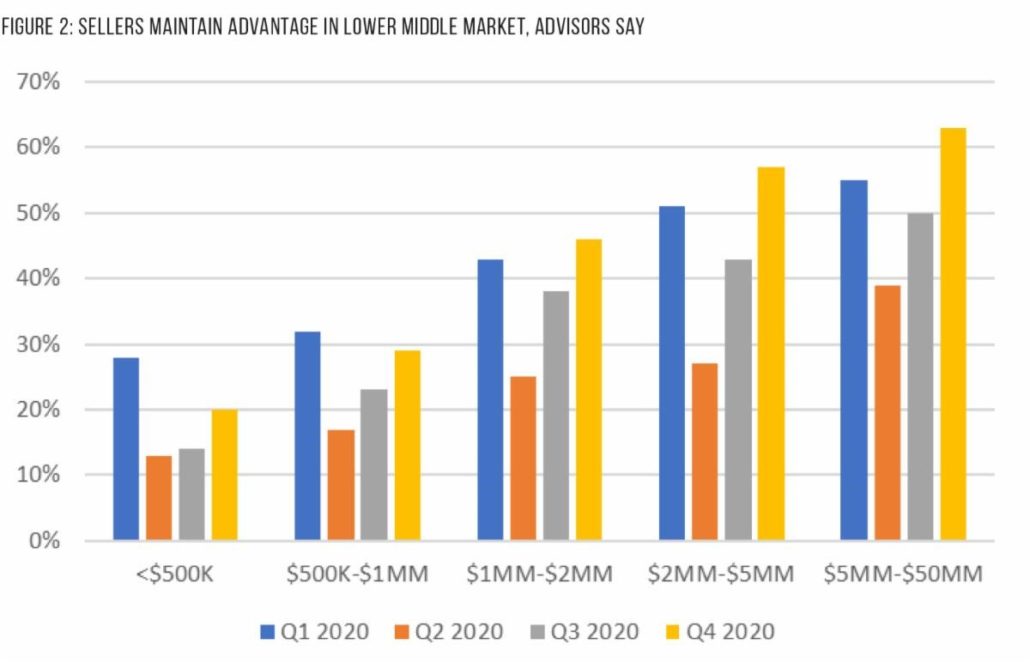
Market Pulse Survey: Still a Seller’s Market

Despite the effects of the pandemic, we continued to experience a seller’s market in the fourth quarter of 2020, for businesses with enterprise values over $2 million.

Presented by IBBA & M&A Source


For further information on M&A market conditions, or to discuss a current business sale, acquisition or valuation need, contact Al Statz, 707-781-8580 or alstatz@exitstrategiesgroup.com.

M&A ADVISOR TIP: Cybersecurity is a Buyer Priority

New research from Datasite reveals that cybersecurity is the #1 cause of buyers withdrawing from a merger or acquisition during due diligence.

Deal makers said about 1 in 10 deals fell through during due diligence. Cybersecurity issues was the cause in 36% of these failed deals, followed by financial weakness, excessive valuation, financial irregularities, and leadership issues.

To ensure that your data security practices will not be a concern for prospective buyers of your company, Exit Strategies Group recommends that you talk to your technology team about potential issues, and consider obtaining a cybersecurity audit from an independent third-party firm. Ask your M&A advisor or CPA for a referral.

Exit Strategies Group is a partner of Cornerstone International Alliance.

Exit Strategies Group Advises on the Sale of Poly Seal Industries

Exit Strategies Group recently advised the owner of Poly Seal Industries on a sale to Goodyear Rubber Company.

Founded in 1974, Poly Seal Industries is a Berkeley, California based manufacturer of molded rubber products for customers in the biopharmaceutical, water & wastewater treatment, chemical, healthcare, food & beverage, and consumer electronics industries. In addition to producing quality custom products, Poly Seal helps customers succeed by providing manufacturing engineering and material science expertise.

Goodyear Rubber Company is a world class custom rubber company with molding, extrusion, mixing and sheeting operations in Southern California and Mexico. They specialize in manufacturing custom elastomer components that facilitate motion. They offer turn-key elastomer solutions, including material formulation and part design as well as both small and large-scale production. This acquisition diversifies end markets for Goodyear and takes advantage of available capacity in its molding operations.

Exit Strategies’ client, Dan Baker, was the owner and full-time president of Poly Seal.  His main objectives were to obtain a good price, retire from the business to spend more time with family, provide an uninterrupted supply of quality products to customers, and retain the real property for future redevelopment.

Detailed planning and execution went into achieving Dan’s objectives. Dozens of carefully selected buyer prospects were identified, contacted and screened, leading to multiple bids. Only buyers that could meet Poly Seal customers’ exacting requirements were considered. A substantial effort was required by the deal team to develop a workable transition plan.

Dan Baker said, “I could not have managed this transaction without Exit Strategies and Roy Martinez. They quarterbacked the deal process from start to finish including deal book preparation, buyer outreach, obtaining bids, negotiations, due diligence, contract, and close.”

Exit Strategies was pleased and honored to deliver a positive outcome for its client and other stakeholders. Roy Martinez and Al Statz led this project for Exit Strategies Group.

Exit Strategies Group is a leading California-based M&A advisory firm with almost two decades of experience selling small-to-medium-sized and lower middle market businesses. Al Statz is the President and Founder of Exit Strategies. He can be reached at 707-781-8580. Roy Martinez has been a business intermediary an certified valuation analyst (CVA) at Exit Strategies for over eight years. Prior to Exit Strategies Roy was VP of Finance at WineDirect where he completed two acquisitions. Roy can be reached at 707-781-8583

Tax changes could accelerate business sales in 2021

To complete deals in 2021, ahead of possible tax changes, owners and deal teams need to act fast.



With the Democrats in the White House and having the tie-breaking vote in the senate, it is likely that taxes on corporations and wealthy individuals will increase during this administration. When and how much are unknown. With COVID recovery as the administration’s immediate priority, many think we will have until 2022.

Biden has proposed raising long-term capital gains tax to 39.6% on income above $1 million, nearly double the current rate. That change would have a major impact on business transfers.

To help understand the impact, I ran some quick numbers … Say a business has $20 million in revenue in 2021 and is growing 5% annually. Assume a consistent 15% EBITDA margin and 6x price/EBITDA multiple at sale. To simplify the math, let’s assume a $0 basis and ignore state taxes and transaction costs.

Option A: The owner sells in 2021.

With EBITDA of $3 million and a 6 multiple, that’s $18 million enterprise value. At the current 20% capital gains rate, the tax liability would be $3.6 million, for net proceeds of $14.4 million.

Option B: The owner holds and grows the business, and sells in 2023.

With 5% annual growth, revenue is now $22 million and EBITDA is $3.3 million. At 6x, that’s an enterprise value of $19.8 million. At a 39.6% capital gains tax rate, the tax liability would be $7.8 million, for net proceeds of $12 million – a significant reduction from $14.4 million.

Under those conditions, a business owner would need to hold and grow the business for six years to yield the same after-tax proceeds.

Yes the owner would receive cash distributions during those years; however, they would also have the risk and headaches of owning the business and would have to delay retirement.

If you are a business owner and are thinking about selling and retiring in the next few years, start talking to your advisors now. It takes 9 months on average to sell a business, and preparing for the sale process can take some time. Work with your financial advisor to understand how much in assets and/or income you need to fund your retirement. Obtain a value and sale readiness assessment from an experienced M&A advisor like Exit Strategies Group. Then have your CPA advise on the current and potential tax burdens now and in the years ahead.


Al Statz is the founder and president of Exit Strategies Group, a leading California based lower middle market M&A advisory and business valuation firm. For further information on this topic or to discuss a potential business sale, merger or acquisition, confidentially, Al can be reached at 707-781-8580 or alstatz@exitstrategiesgroup.com.

M&A Advisor Tip: ESG Diligence on the Rise in M&A

Companies that are able to showcase their Environmental, Social and corporate Governance (ESG) capabilities stand to gain a competitive advantage and make themselves more attractive to potential acquirers.

ESG issues cover a wide range of corporate practices that could include everything from environmental stewardship, health and safety policies, employee well-being, community support, to corporate culture issues.

In recent research from Datasite, 84% of dealmakers rated ESG as an “important/very important” M&A due diligence consideration. And 78% have terminated M&A discussions due to concerns about a target company’s ESG credentials.

We are definitely seeing buyers pay greater attention to environmental, social and corporate governance issues in our sell-side M&A engagements. From a buyer perspective, misalignment in these areas reduces valuation and increases integration challenges and costs. As a result, we are incorporating more ESG analysis into our company valuations and exit planning assessments, and making more of these types of disclosures in our offering memorandums.


For advice on exit planning or selling a business, contact Al Statz in Exit Strategies Group’s Sonoma County California office at 707-781-8580 or alstatz@exitstrategiesgroup.com.  Exit Strategies Group is a partner in the Cornerstone International Alliance.


Exit Strategies Group Represents Shareholders in the Sale of Gibson Engineering

Exit Strategies Group is pleased to announce that Applied Industrial Technologies has acquired Gibson Engineering Company, a value-added distributor and system integrator of industrial automation technologies. Exit Strategies Group served as the exclusive M&A advisor to Gibson shareholders.

Gibson Engineering, based in Norwood, MA,  distributes advanced robotics, vision systems, sensors, motion and machine controls, material handling and other industrial automation products, and integrates mixed technology systems. For over 40 years, Gibson has been a trusted supplier partner to major OEM and end user manufacturers throughout the Northeast and Mid Atlantic region. Under the principled leadership of CEO Dan O’Brien, Gibson Engineering has developed into one of the most capable and respected automation solution providers in North America.

Al Statz, who led the engagement for Exit Strategies said, “Our sale process generated keen interest from several top firms. Applied ultimately presented the right balance of strategic opportunities and cultural alignment for our client. I am confident that Gibson’s suppliers will benefit from this partnership and I look forward to seeing what the Gibson team can accomplish as part of the Applied family.”

Financial terms of the transaction were not disclosed.

About Applied Industrial Technologies: Publicly traded AIT is a leading multi-national distributor and technical solutions provider of industrial motion, fluid power, flow control, automation technologies, and related maintenance supplies. Read the Applied news release.

About Exit Strategies Group, Inc.:  Founded in 2002, Exit Strategies Group is a boutique M&A advisory firm providing full-service sell-side representation, business valuations and exit planning assistance to owners of private lower middle market businesses in automation, material handling and other industries.

Key Deal Terms – Fall 2020

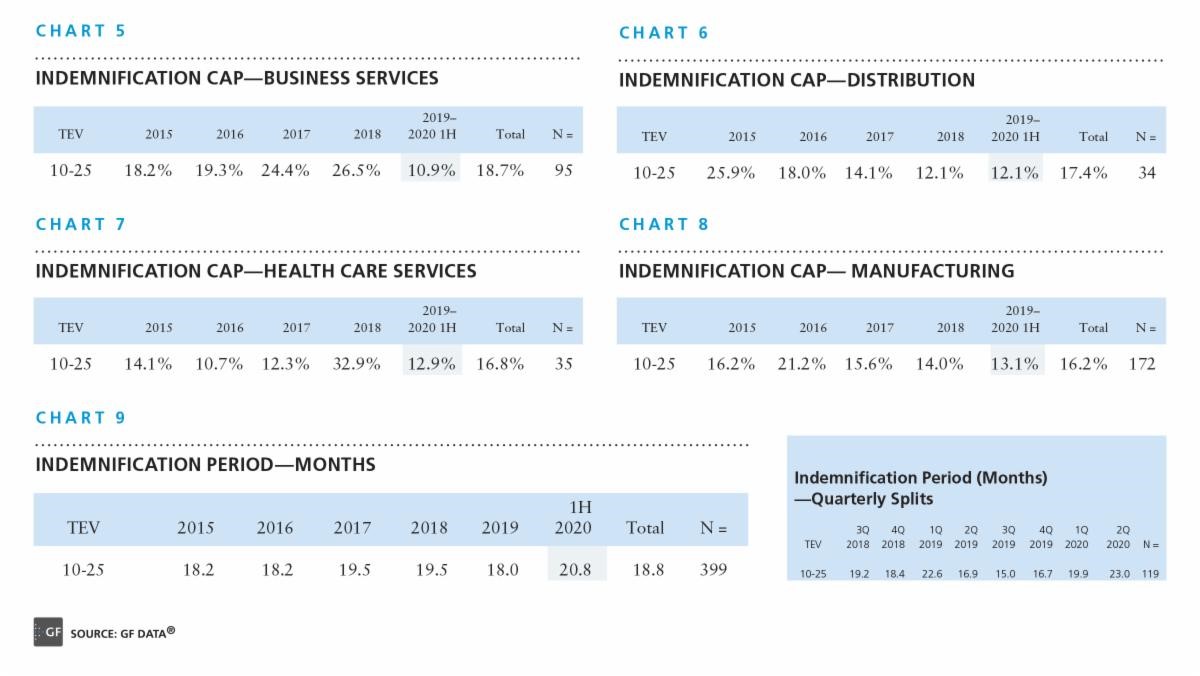
GF Data collects and publishes proprietary business valuation, volume, leverage and key deal term data contributed by over 200 lower-middle market private equity groups and other M&A deal sponsors.  Two of the acquisition deal terms that they monitor are the survival period¹ on general reps and warranties and the cap on indemnification² against breaches of general reps and warranties.   The following table shows these limits for deals in the $10 million to $25 million enterprise value range.

The indemnity cap in the first six months of this year across all industries was 10.0% of the purchase price, well below the 17.1% average from 2015 to present.  The indemnification period was 20.8 months, up slightly from the 2015-to-present average of 18.8 months.

  1. Indemnification cap refers to the general indemnification provided by the seller to the buyer against breaches of reps and warranties. This does not include carveouts for specific issues or items. For example, parties often agree that the general cap will not apply in the event of fraud.
  2. Survival period refers to the period after closing during which a buyer may assert a breach of the reps and warranties against seller. Again, this does not include carveouts. For example, exposure on tax, environmental, and ERISA issues often exceeds the general survival period.

For assistance with selling a lower middle market business, contact Al Statz in Exit Strategies Group’s Sonoma County California office at 707-781-8580 or alstatz@exitstrategiesgroup.com.  Exit Strategies Group, Inc. is a partner in the Cornerstone International Alliance.

M&A Advisor Tip: Be able to articulate your growth story.

Buyers want to acquire businesses with profit AND growth potential.

Where is your business headed? Will it still be relevant in 5 years? Where will growth come from? How will it outperform its industry peers?

If you don’t have an expansion strategy at the ready, talk to an M&A advisor or an exit planner. We can uncover which parts of your business are most attractive to buyers. Then we can help you plan to increase value – whether that means continuing to operate the business on your own or taking on an equity partner to help you take it to that next level.

For advice on exit planning or selling a business, contact Al Statz in Exit Strategies Group’s Sonoma County California office at 707-781-8580 or alstatz@exitstrategiesgroup.com.  Exit Strategies Group is a partner in the Cornerstone International Alliance.


M&A Advisor Tip: How you know when it is time to sell

It may be time time to sell your business when …

  1. Revenue has plateaued and you no longer see how to grow the business.
  2. You’re not sure how to reach the next level on your own.
  3. Your industry is consolidating around you.
  4. The current probable selling price of your business will satisfy your personal financial goals and a major economic or political shift could erode value.
  5. You’d like to diversify your assets and are ready take some chips off the table.
  6. Your interest and passion for the business are waning.
  7. You prefer to do something different with your money and/or time.

With smart preparation, you can ensure that your business is ready to sell when you are. It’s time to start the conversation.

For advice on exit planning or selling a business, contact Al Statz in Exit Strategies Group’s Sonoma County California office at 707-781-8580 or alstatz@exitstrategiesgroup.com.  Exit Strategies Group is a partner in the Cornerstone International Alliance.

Better to sell early in consolidation. Here’s why.

Consolidation is inevitable in maturing industries.  As an M&A advisor working with owners of private wholesale distribution and manufacturing companies, one of the questions I get asked is whether it is better from a valuation perspective to sell early in a consolidation phase, or hold off.  My answer is always case-specific, but generally earlier is better, all else being equal.

Before I explain why, I want to point out that industry consolidation is not always at the top of a seller’s list of sale timing considerations. More important factors may be:

What is your exit time frame?

Next year or so?  Three to five years?  Five or more years?  The answer is often driven by how much money you (or a majority of the shareholders) will need to retire or fund your next venture. Obviously, as with any investment, the shorter the time frame, the more conservative one should be with respect to anticipated returns.  Maybe the value today isn’t quite what you think it can be in the not too distant future – but eliminating risk may be worth a lower price tag.

For a seller who either wants to stay and manage the acquired/merged business or help the consolidator in a strategic (e.g. corporate development) role, that tail of income is above and beyond the sale consideration. Sellers who prefer to buy a boat and sail to the Bahamas had better have a strong management team to lock that future strategic value down. If not, they will likely be passed on by the buyer for another acquisition with a stronger management team and lose out on that strategic value.

Is your company performing well?

Last I checked, fundamental financial performance was still king when it comes to acquisition values. If your business is performing well (relative to industry peers and alternative investments) and further improvement is likely, now may be your best opportunity to maximize value in an M&A sale process.  If not, you’ll have to decide if and how you and your management team are going to change that performance and by when. And, by the way, what is your track record of achieving past projections?

Is the macro-environment favorable?

Does the economic outlook portend for several more years of strong economic growth, or is there increasing uncertainty or even signs of an imminent slow down?

If the former is the case, perhaps you have time to continue to grow revenues and profit margins to increase value and better position your business for future sale.  If the latter is likely, are you prepared financially and mentally to wait it out indefinitely and hope to again consider achieving liquidity several years from now?  If that’s not an option, maybe now’s the time to take some or all of your chips off the table.

Conditions can change quickly for all sorts of reasons and you can be stuck, not just with a reduction in valuation, but closed private capital markets altogether.  M&A came to an abrupt halt in Q2 of this year and has only recently started showing signs of life in certain industries. And look at what happened in the wake of The Great Recession.

Why earlier is usually better.

Industries consolidate at different times and in different ways.  So, to make my answer more informative, let’s use the example of industrial distributors, where regional and national players have acquisition-based growth strategies. Driving consolidation are mergers and product line expansion by upstream manufacturers (suppliers) and both vendor reduction programs and consolidation by downstream customers.

  1. If I’m an aspiring consolidator/strategic acquirer, I’m probably willing to pay a nice premium for my first acquisition in a particular geography – to attract the best of the options available and secure that foothold ahead of my competitors.  Or I may want to make a statement with regard to the quality of organization I intend to build.  Hence, there is more of a strategic component in the valuation of earlier platform acquisitions, whereas later add-ons may be more simply about market development and earnings expansion.
  2. Further, the first couple of acquisition targets are likely to have more to say (and be credited for) relative to the manufacturers the consolidator aligns with.  As the map fills in, later acquisitions may be forced to discard certain lines and replace them with others to conform to the acquiring organization.  You can count on the acquirer considering the revenue loss, risks and cost of making those transitions when determining the value of an acquisition.
  3. Early on, there are likely to be more strategic acquirers in the market. As the market consolidates further, the number of viable strategic match-ups will decline, which may favor the remaining buyers and reduce the likelihood of a strategic premium for sellers. Eventually, the only option for the last few independents standing may be to sell to pure financial buyers – such as private equity groups (if the independent is large and profitable enough), management teams, families and private individuals.  For some owners these are perfectly acceptable options, for others they are not.
  4. Then there is the likelihood that consolidators will eventually have competitive advantages over independent operators – in terms of authorizations and terms with suppliers, access to proprietary products, lower administrative costs, ability to attract and retain talented employees, better access to growth capital, financial stability, etc.  To the extent true (which sometimes it is not — there are associated disadvantages) the market share and value of the smaller independents will gradually deteriorate.

Conclusion

Going to market early in a consolidation phase is likely to produce a stronger valuation than waiting around, all else being equal. However, when making exit plans, company owners should carefully consider shareholder needs, business performance and market conditions, in addition to what stage of maturity their industry is in.

*          *          *

Al Statz is the founder and president of Exit Strategies Group, a leading lower middle market M&A advisory and business valuation firm. For further information on this topic or to discuss a potential business sale, merger or acquisition need, confidentially, Al can be reached at 707-781-8580 or alstatz@exitstrategiesgroup.com.