Will appear on Seller pages – RECENT SELLER ARTICLES

Current Market Multiples for Main Street Business Sales

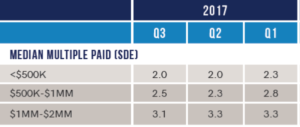
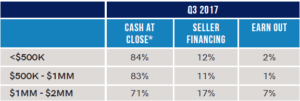
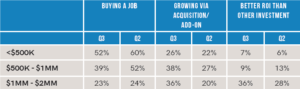
Each quarter, The International Business Brokers Association (IBBA) and M&A Source together with Pepperdine Private Capital Markets Project and the Graziadio School of Business and Management at Pepperdine University publish a quarterly national survey of business brokers and M&A advisors called the Market Pulse Survey. Price multiples and other key metrics in the Main Street Market section of the Q3 2017 survey are presented below.

Main Street businesses are defined as those with enterprise values up to $2.0 million.


MEDIAN MULTIPLES PAID FOR MAIN STREET BUSINESSES


SDE is Sellers Discretionary Earnings, which is defined as earnings before owner/GM compensation (one full-time working owner), depreciation and amortization, non-operating income & expenses, nonrecurring income & expenses, interest income & expenses, and taxes.


PORTION OF SALE PRICE RECEIVED AS CASH AT CLOSE


WHY SELLERS WENT TO MARKET


WHAT WAS MOTIVATING BUYERS

Help! I Need a Broker to Sell My Company

I was recently talking with a business owner who is considering selling his California company. He had found my contact information online, and while he was interested in getting started, he really didn’t know how to evaluate a business broker’s credentials for a sale engagement. Sellers are often unsure what questions to ask. For this reason, I like to spend 15 minutes to share my relevant M&A experience, my career history, our firm’s processes and resources, and our capacity to get a deal done for the prospective client. In this blog post, I’ll focus on pertinent questions that a seller should ask when interviewing a prospective business broker or M&A intermediary.

Many sellers base their selection strictly on how well they like the broker, or on “gut feel.” While it’s vital that a seller and business broker get along well together, a seller should consider this “Likeability Quotient” along with more objective criteria.

Factors to consider when selecting a business broker:

  1. How long has the broker been selling businesses?
  2. How many transactions has the broker completed?
  3. What is the broker’s closing success rate?
  4. Does the broker’s firm have exceptional valuation expertise?
  5. How extensive is the offering memorandum that the broker prepares?
  6. Does the broker have specific domain knowledge in your industry?
  7. What size deals does the broker’s firm typically work on?
  8. How many client engagements does the broker work on at any time?
  9. Does the broker work full-time on deals, or is business brokerage a side-business?
  10. How involved does the broker stay during the due diligence and closing phases of a transaction?

Hiring the right broker to sell your business is a critically important decision. Asking the above questions will help you  select a capable, honest and hard-working business broker by objectively evaluating their background, credentials, work ethic, and capacity for successful deal making. With these questions answered to your satisfaction, add bonus points if the broker has a high Likeability Quotient.

When is the Right Time to Sell My Business?

BOOK REVIEW —

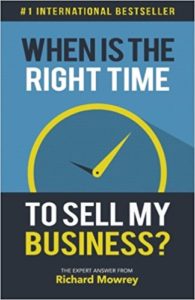
I don’t recall the last time I recommended a book, but today I feel compelled to tell business owners about an excellent new book titled, “When is the Right Time to Sell My Business?”

This book not only helps you decide when to sell your business, but will also help you understand its value from the perspective of willing buyers, increase its value and marketability, and choose and plan your best exit option. If you are a private business owner; following the recommendations in this book will help you sell for more money, on your terms and time-frame, without regrets.

Expect a great return on the time you’ll invest in reading this book. Mr. Mowrey presents a sensible and proven approach to selling a business. It’s a quick read that covers a lot of important ground at just the right depth for busy business owners, and it’s one that I suspect you’ll take notes in and refer back to as you approach your exit. Mr. Mowrey pours a tremendous amount of valuable insights and sound recommendations into 188 pages. I can’t say that for most of the books on this subject authored by other so-called experts.

CPA’s, transaction attorneys, wealth managers, M&A intermediaries and business appraisers would also do well to read this one.

Purchase this Book on Amazon

Full Disclosure — Not only is Rich Mowrey a four-time business owner and seasoned valuation expert and transaction intermediary, he’s also a colleague of ours who we met through our national business valuation and M&A trade associations.

The process outlined in Rich’s book closely mirrors what Exit Strategies does for our clients. Feel free to contact one of our California-based advisors with any business valuation or M&A brokerage questions or needs.

Forbes Article: Which Is Better, A Financial Buyer Or A Strategic Buyer?

Image result for forbes logoI thought would share this brief Forbes article that came across my transom early this morning. I generally agree with author John Warrillow’s comments on Strategic versus Financial buyers. If your goal is to maximize value and liquidity today, and you’re not looking for an equity partner to help you build longer term enterprise value, a strategic buyer generally produces the best outcome. Having multiple strategic buyers at the negotiating table as a result of a structured M&A sale process produces even better results!



The article …

If you decide to sell your business to an outside acquirer, you’re going to have to decide between a financial and a strategic buyer. Understanding the different motivations of these two buyers can be the key to getting a good price for your business.

A financial buyer is acquiring your future profit stream, so they will evaluate your business based on how much profit it is likely to make in the future and how reliable that profit stream is likely to be. The more profit you can convince them your company will produce, the more they will pay for your business.

But there is a limit to how much they will pay, … READ THE FULL ARTICLE ON FORBES.COM

Is Private Equity the Right Solution for Your Exit?

Is Private Equity the Right Solution for Your Exit? Private Equity Groups (PEGs) are disciplined buyers of lower middle-market companies. Most have cash funds and lender relationships in place for the right acquisition opportunities. PEGs often recapitalize a company, where they purchase a majority or minority interest. They bring growth capital and business acumen to […]

Targeting Strategic Buyers for Your Company

One aspect that separates M&A advisors from business brokers is the approach used to identify and target buyer candidates. The typical business brokerage approach is largely advertising based. They place a description of the seller’s business on several websites (BizBuySell and others) and then simply await inquiries. Business listing websites are effective for “main street” businesses (restaurants and auto repair shops) where the buyers are individuals and ad-hoc partnerships. However, in the lower-middle market, specialized corporate buyers aren’t shopping on these sites. Most strategic buyers don’t even realize they’re buyers, yet.

We’ve had great success targeting and selling companies to strategic buyers and industry-focused private equity groups.

Early in my career when I worked at WebEx (www.webex.com) in business development, we would conduct a quarterly exercise to identify potential strategic partners. In this half-day exercise, we would brainstorm a list of all possible market segments where we expected to find partnership value, and then identify the top players in each space. That simple exercise directed our strategic actions and objectives for the quarter. Employing a similar approach for my sell-side M&A clients, I’ve found that strategic targeting is the most effective way to find the right buyer.

Where are you most likely to find a strategic buyer for your company?

I like to start by brainstorming the low hanging fruit. This is an exercise where the seller client and the M&A advisor benefit from close collaboration. Some market segments will be obvious, such as customers, partners (resellers, VARs, OEMs), competitors, vendors, and distributors. Other fruitful segments are less obvious and often overlooked. Exit Strategies has a systematic approach to expanding this universe of target business segments.

For each of my sale engagements, I develop and maintain a list of all strategic buyer candidates by market segment, and I share that list with my client. This exercise requires deep research to generate a comprehensive list of companies, followed by more exploration to identify the right individuals at these companies. Exit Strategies has several databases that help with this. Subsequent outreach campaigns include phone calls, email, LinkedIn, and good old snail mail.

It’s a ton of work, but the results of a strategic targeting process are well worth the considerable effort. Of course, our client’s identity is protected until the buyer has been properly screened and an NDA has been signed.


Six Reasons NOT to Skim

Pulling unreported cash receipts out of a business is indefensible and unwise under any circumstances, but particularly if the owner expects to exit in the next 3-5 years.

All of us during our childhood were offered the parental edict: “Don’t do it, you are only hurting yourself.” So “why”, you may ask . . . now that you are a grown adult, “should I not skim?”

Many reasons immediately come to mind and I am certain that we could all come up with many more, but in the interests of brevity, I’ll keep it to six reasons.

  1. Skimming is against the law. Tax evasion is a felony.
  2. Management of your business becomes more challenging. Skimming requires you to underreport revenues which means your cost of sales percentage rises. Cost containment and inventory control are more difficult to assess.
  3. Loss of Employee, Partner and Spousal Trust. You set a bad example and create a fertile ground for others to steal. Worse yet, a disgruntled employee or retaliatory ex-spouse or partner could report you.
  4. Bank Loans are difficult to secure, for you and potential buyers.
  5. The value of your business declines.
  6. The marketabilty of your Business is severely compromised. You cannot expect potential buyers to trust you, let alone make a “leap of faith” and pay a premium for your business on the merits of unreported, unverifiable income.

Hopefully this doesn’t apply to you. But, if it does, what’s the solution? I refer you back to your childhood: Don’t Do It.

  1. Stop Skimming
  2. Clean up your books.
  3. Effectively manage your business, using reliable financial records.
  4. Redeem your credibility with your staff, your partners and your bank.
  5. Add value to your business as an ongoing entity or as a potential sale. The amount you no longer skim can easily be worth 2 – 5 times its selling value, or more, depending on the degree of skimming and the size and nature of your business.

In summary, each of us at some point makes a life defining decision … “Do I want to eat better or sleep better?”  You make the call.  As it relates to preparing a business to sell, you can do both.

Don Ross is a seasoned business broker with Exit Strategies Group. He can be reached at 707-778-0210 or donross@exitstrategiesgroup.com. 

Exit Strategies Advises RST in Strategic Sale to Subsite Electronics

Exit Strategies Group, Inc. (ESGI) is pleased to announce the acquisition of its client, robotic inspection equipment manufacturer RS Technical Services, Inc. (RST), by Subsite Electronics, a Charles Machine Works company. Exit Strategies served as exclusive M&A advisor to RST.

Acquired by:

Since 1984, R.S. Technical Services, Inc. (rstechserv.com) has been a leader in the design and manufacture of robotic video inspection equipment used to monitor and repair municipal water and wastewater collection and conveyance systems, mainly pipelines too small to allow man entry. Its systems are designed around a unique technology that incorporates all power and control functions into a single conductor, making its equipment more reliable and safer to use than competing solutions. RST has facilities in Kentucky and California.

Subsite Electronics (subsite.com), a Charles Machine Works company, manufacturers utility locators and horizontal directional drilling (HDD) guidance systems. The RST acquisition adds proven remote video inspection capabilities to Subsite’s line of underground awareness solutions. Employee-owned Charles Machine Works, founded in 1902 in Perry, Oklahoma, has several brands and divisions, and is perhaps best known for its Ditch Witch brand of HDD and trenching equipment. For more information visit charlesmachine.works.

Al Statz, President of Exit Strategies, who led the transaction, stated “We are proud to have represented the owners of RST in this successful sale to Subsite. Our team identified, profiled and had preliminary talks with over 100 target buyers, both strategic and private equity, and qualified 6 finalists. Subsite was selected not only on economic terms, but also because they demonstrated a strong culture of customer care, innovation, integrity and commitment to employees that was important our clients.”

For advice and representation in the valuation, sale, merger or acquisition of your company, contact Al Statz at 707-781-8580 for a free confidential consultation. Financial terms of the RST-Subsite transaction will not be disclosed.

About Exit Strategies

Exit Strategies Group, Inc. (ESGI) is a California-based M&A brokerage and business valuation firm focused on producing exceptional exits for closely-held and family owned lower middle-market companies. ESGI brings M&A experience, process management and close attention to detail to help companies sell, merge, recapitalize and acquire businesses successfully. Our advisors have sold companies in a variety of industries including sophisticated technology design, manufacturing, distribution and value-added services.

Buy Low, Sell High

Timing is everything. Almost everyone is familiar with the world’s greatest tip to stock investors, “buy low, sell high.” These simple words of wisdom are equally useful to private business owners; however, sage advice is not always easy to follow in the same moment you’re reaping the benefits of high profitability.

With the current bull market in its eighth year, the lower middle market is economically healthy across many industries. I talk to business owners and CEOs every week. By and large, they are experiencing year over year increases in revenues and profitability – and therefore, exit strategy is one of the last things on their mind.

Selling in an upbeat, healthy economic climate makes sense; at the cost of incremental short-term profits – which are effectively turned over to the acquiring buyer. However, it’s difficult to gauge just how long the bull market will last. A rising tide surely lifts all boats; but it’s wise to consider that tides go in both directions.

There are many factors at play, when contemplating the best time to sell your business. As M&A intermediaries, we see first hand that buyers pay higher valuations for companies that show rising revenue and profits over several years, and when it is reasonable to expect continued growth in the years ahead. And likewise, buyers pay less for companies when the inverse is true.

While many aspects of your business are unpredictable, certain things can be predicted with fairly good accuracy; for example, the movement of tides, and the usefulness of simple stock advice. Buy low, sell high.

Is 2017 a good year to sell my company?

Sellers often ask us if it is a good time to sell their business. My response is usually, “yes, but it depends”.  The optimum time to sell a particular business depends on many factors, and this article discusses some of them.

First of all, timing depends on the company:

  • How are its business fundamentals?
  • Is it growing? Flat? Shrinking?
  • Is it profitable? How is the quality of earnings?
  • What is the outlook for the business for the next 5 years?
  • Does the company have a good management team in place if the owner leaves?
  • Does the company have intellectual property? Is it robust? Is it protected?
  • Does the company have concentration risk? Customer, supplier, etc.?
  • How many family members does the company employ?
  • How many personal expenses does the owner run through the business?
  • Is working capital being optimized?

The state of the industry is important too:

  • How are industry fundamentals?
  • Is the industry growing? Flat? Shrinking?
  • Are there industry buyers?
  • Is the industry consolidating?
  • Are there any trends or changes on the horizon that could have an impact (good or bad) on your company?

The economy also matters, and market conditions factor in. When the world, U.S., state or local economy stalls, it can be difficult to sell businesses, at any price. Economic factors include:

  • Is the economy growing? Flat? Shrinking?
  • Is the economy stable? Any risks looming?
  • What is going on with interest rates?
  • What is the status of the Mergers and Acquisitions (M&A) market? Are strategic buyers and Private Equity Groups (PEGs) active or sitting on their wallets?
  • Are lenders lending?
  • At the low end of the market, are individual buyers buying? This may be contra-cyclical. In good times, individuals may not want to leave lucrative jobs. On the flip side, when people lose their jobs, some decide to buy a small business.

Last, but not least, your situation as the owner has a major influence on sale timing:

  • Why sell? Retirement? Illness? Death? Divorce? Burnout? Generally its best to have a good reason.
  • What are you planning to do post-sale?
  • If the business sells at its probable selling price, will you have the funds to support those plans, after taxes? Will you need all cash, or can your provide some seller financing?
  • Are you interested in retaining a stake in the company for investment?
  • Do you have family or management that want or expect to take over the business? Are you willing to leave some money on the table (vs. a strategic sale)?
  • How do you want to be involved with the company after the sale? Is there a time by which you have to be completely out?
  • How important to you are the ongoing success of the company, continued employment of staff, customer or supplier continuity, etc., versus maximizing proceeds?

There are more questions, but this is a good start. The point is, deciding when to sell a business is complex and deserves thoughtful analysis. Some of the answers will be easy, others require more analysis and assistance.

So, is 2017 a good year to sell?

For the first time in a long time, most small-to-medium-sized businesses can look back and see five solid years of financial performance. And, importantly, owners and investors can look forward with an expectation of good years to come. It has taken almost a decade, but most companies have completely shaken off the effects of the Great Recession. Furthermore, in most industries, strategic acquirers, private equity groups and lenders are writing checks and valuations are strong.

So, fundamentally, YES, 2017 is a very good year to sell, in the U.S., in California and in the Bay Area, and in nearly all industriesOf course, the full answer depends upon your specific company and personal circumstances.

Contact Roy Martinez with an immediate need or for further information on exit strategies and the market for your business.